


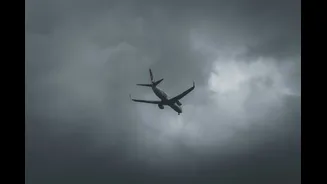
The Prime Suspect: Turbulence
The most common culprit behind a sudden drop is turbulence. Think of the air as a fluid, much like the ocean, with currents, waves, and eddies. When a plane flies through these invisible pockets of disturbed air, it can be jostled, leading to a bumpy
ride. Pilots may choose to descend to a lower altitude to find smoother air. This is a strategic move for passenger comfort, not an emergency measure. Modern aircraft are engineered to withstand incredible stress, far more than even severe turbulence can dish out. While it feels dramatic, the plane is simply riding the air currents, and the pilots are taking steps to make your journey less bumpy.
Following Orders from the Ground
A sudden descent is often not the pilot's decision alone but a direct instruction from Air Traffic Control (ATC). The sky is a busy place, and ATCs are like celestial traffic police, ensuring every aircraft maintains a safe distance from others. A controller might instruct a pilot to descend to avoid another aircraft, navigate around a weather system, or to sequence the plane for its eventual landing. These are routine, everyday instructions in the world of aviation. The descent might feel abrupt to a passenger, but for the crew, it's simply part of a highly coordinated and safe system of air traffic management.
The 'Step Descent' Manoeuvre
On longer flights, you might experience what's known as a 'step climb' or its counterpart, a 'step descent'. As an aircraft burns fuel, it becomes lighter. To fly more efficiently, pilots will periodically climb to a higher altitude where the air is thinner. Conversely, when preparing for arrival at a busy airport, pilots might perform a step descent. Instead of one long, gradual descent, they descend in stages, levelling off at different altitudes as instructed by ATC. Each 'step' down can feel like a sudden drop, but it's a planned and fuel-efficient way to manage the approach.
Adjusting for Weather and Wind
Pilots are constantly seeking the smoothest and most efficient path through the sky. Sometimes this involves making altitude adjustments to avoid unfavourable winds or to take advantage of a helpful tailwind. They may also descend to get below layers of ice-forming clouds or other weather phenomena. This can be particularly true with 'clear-air turbulence' (CAT), which occurs in cloudless skies, often near jet streams, and is invisible to both the eye and conventional radar. A pilot encountering CAT will often change altitude to find a smoother layer of air, which can feel like a sudden drop.
A Note on Emergency Descents
It's important to acknowledge that in very rare situations, a rapid descent is performed for a genuine emergency, such as a loss of cabin pressure. In this scenario, pilots are trained to descend quickly to an altitude of around 10,000 feet, where the air is breathable without supplemental oxygen. This is a practised, controlled manoeuvre, not a chaotic fall. You would know if this were happening; oxygen masks would deploy, and the crew would provide instructions. However, these events are exceedingly rare, and the vast majority of sudden descents are for the routine operational reasons listed above.