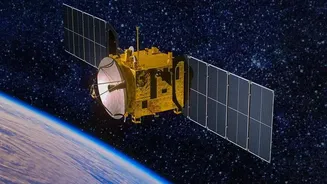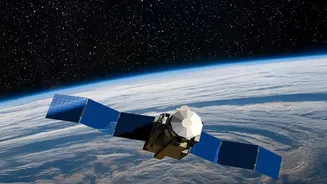









A Legacy of Observation
The story of EOS-05 is one of ambition and persistence. While the specific EOS-05 mission faced a setback, the advanced capabilities designed for it live on. The Indian Space Research Organisation (ISRO) channeled this technology into subsequent successful
missions, ensuring that the intended 'eye in the sky' became a reality. For instance, many of the ocean-centric goals are now being fulfilled by its successor in the broader Earth Observation program, EOS-06, also known as Oceansat-3, which launched in November 2022. This ensures the continuity of crucial data for the nation.
The All-Seeing Instruments
The core of this Earth-observation prowess lies in a suite of sophisticated instruments. The technology includes advanced imagers capable of operating across multiple spectral bands. One key instrument is the Ocean Colour Monitor (OCM), designed to observe the colour of the ocean, which reveals information about phytoplankton and the marine ecosystem. Another is a Scatterometer (SCAT), a specialised radar that measures the roughness of the sea surface to calculate wind speed and direction, a critical input for weather forecasting. A Sea Surface Temperature Monitor (SSTM) was also developed to provide thermal imaging of the oceans, vital for understanding cyclone formation and intensity. Together, these instruments provide a comprehensive health report of our oceans and atmosphere.
From Data to Daily Life
The data from these satellites doesn't just stay in scientific labs; it has a profound impact on the ground. The Ocean Colour Monitor's data on phytoplankton is used to identify Potential Fishing Zones (PFZs), which are shared with fishing communities via text messages, helping them save fuel and improve their catch. The wind data from the scatterometer is invaluable for tracking the formation and path of cyclones, enabling more accurate warnings and saving lives. This capability allows for near-continuous monitoring of the Indian subcontinent, which is a game-changer for disaster management agencies trying to assess floods, forest fires, and other rapidly evolving events.
The Geosynchronous Advantage
A significant update in India's capability is the move towards a geosynchronous orbit for some observation satellites, like the successfully launched EOS-05 on September 4, 2026. Unlike satellites in low-Earth orbit that pass over a location periodically, a satellite in a geosynchronous orbit at about 36,000 km altitude remains stationary over a specific region. This allows for persistent, 24/7 monitoring of the Indian subcontinent and surrounding oceans. This 'eye in the sky' can provide near-real-time imagery, a huge advantage for both civilian applications like weather monitoring and strategic uses such as border surveillance.
India's Role in Global Monitoring
The data generated isn't just for India. ISRO makes much of this data available to the global scientific community. For example, wind vector data from Oceansat-3 is used by international weather agencies like EUMETSAT to improve global numerical weather prediction models. By tracking the global biosphere, including vegetation on land and phytoplankton in the ocean, these satellites contribute significantly to our collective understanding of climate change, ocean dynamics, and food systems. This collaborative approach positions India as a vital contributor to the planetary effort of monitoring Earth's health.