






Deep within our own galaxy, a cosmic drama has been unfolding. For decades, astronomers hunted for a phantom: a small black hole firing a jet of particles at near-light speed right at us. Now, they've found their prime suspect.
A Cosmic Object Hiding in Plain Sight
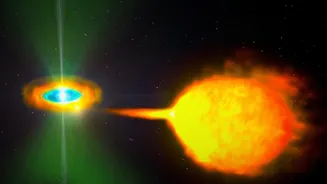
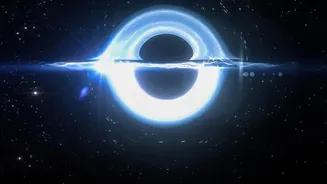
The object at the centre
of this discovery is named IRAS 18293-0941. It’s a binary system, located about 12,000 light-years away, where a black hole roughly 10 times the mass of our Sun is locked in a dance with a massive companion star. The black hole's immense gravity strips material from the star, pulling it into a swirling disc of hot gas. While some of this material falls into the black hole, a portion is channelled and violently ejected from its poles in two opposing jets. First catalogued in 1983, this system remained a mystery for decades, largely because it's shrouded by thick clouds of interstellar dust, making it almost invisible to standard optical telescopes. It wasn't until astronomers used powerful radio telescopes that they noticed a crucial clue: a bright, one-sided structure, hinting that a powerful jet was being aimed almost directly at Earth.
What is a Microblazar?
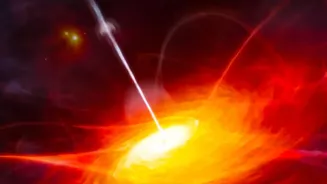
To understand the excitement, we need to talk about blazars. These are some of the most energetic phenomena in the universe. They occur when a supermassive black hole at the centre of a distant galaxy fires a jet of particles and radiation directly towards us. The jet, travelling at a significant fraction of the speed of light, appears incredibly bright due to an effect called relativistic beaming. For years, astronomers theorised that a smaller version, a 'microblazar', should exist in our own galaxy, powered not by a supermassive black hole but by a stellar-mass one like that in IRAS 18293-0941. Finding one, however, is difficult. The jet-producing phase is short, and the jet has to be aimed precisely at Earth for the object to qualify. IRAS 18293-0941 is the first truly compelling candidate for this long-sought-after class of object.
The Smoking Gun: A Jet Firing at Earth
The recent breakthrough came from an international team using a network of radio telescopes, including the European VLBI Network and the MeerKAT array in South Africa. These observations confirmed that the system is indeed launching a jet of plasma at an incredible 75% of the speed of light, aimed almost squarely in our direction. The effect of relativistic beaming makes this Earth-facing jet appear intensely bright, while the jet firing in the opposite direction is almost invisible. However, astronomers could detect the effects of this second jet, which has carved out a bubble in the interstellar medium about 100 light-years wide where it slams into a dense cloud of gas. This discovery provided the 'smoking gun' evidence that elevates IRAS 18293-0941 from an interesting source to a top-tier microblazar candidate. While the phrase 'firing a jet at Earth' sounds alarming, scientists have confirmed there is no danger to our planet from this immense distance.
A Natural Laboratory for Extreme Physics
The confirmation of a microblazar within our own galaxy is a huge deal for astrophysics. Blazars are so distant that it's impossible to study their inner workings in detail. A nearby analogue like IRAS 18293-0941 provides a local laboratory to understand the physics of how black holes launch these incredibly powerful jets. It allows scientists to test theories on accretion disks, particle acceleration, and how black holes pour energy into their surroundings. Furthermore, the interaction between the jet and the neighbouring gas cloud might be a clue to another cosmic mystery: the origin of ultra-high-energy cosmic rays. The collision creates a shock that accelerates particles to energies 100 times greater than what can be achieved at the Large Hadron Collider on Earth, making this microblazar one of the most powerful particle accelerators in our galaxy.