




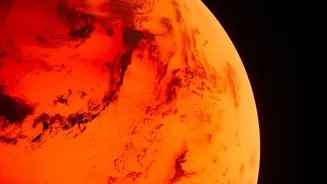
A Planet's Hidden Layer
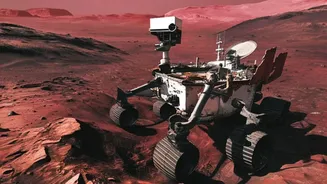
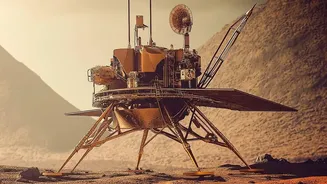
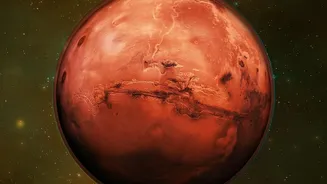
For years, scientists have known about a curious boundary deep inside Mars, about 24 kilometres below the surface. This knowledge came courtesy of NASA's InSight lander, a robotic geologist that listened for 'marsquakes'—seismic waves from meteor impacts
and internal shifts—to map the planet's interior. These waves changed speed as they passed through the boundary, telling scientists something different was down there, but what it was remained a puzzle. The prevailing idea was that Mars had a relatively simple crust, perhaps with layers of buried sedimentary rock, hinting at a past with more water.
From Sediment to Magma
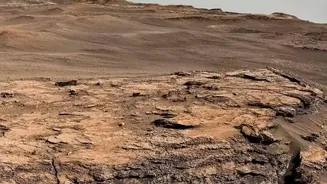
The team at Oxford's Departments of Earth Sciences and Statistics took a fresh look at the InSight data. They ran complex models, comparing the seismic readings against the physical properties of hundreds of possible rock compositions. Their findings, published in Nature Astronomy, point to a dramatic new conclusion. The layer isn't sedimentary at all. Instead, it marks a sharp divide between two types of rock formed by volcanic processes. The upper crust is 'mafic' rock, the kind of basalt common on the Martian surface. But the layer below is 'ultramafic'—rock that is far richer in iron and magnesium and lower in silica. This composition is what you get when magma cools, separates, and crystallizes over immense timescales.
A More Dynamic, Earth-Like Past
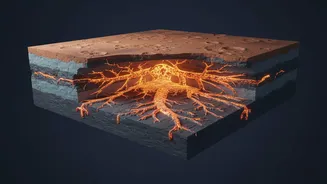
This reinterpretation has huge implications. It suggests Mars once hosted vast, interconnected magmatic systems deep within its crust, a process called 'transcrustal magmatism'. Molten rock from the mantle didn't just erupt from isolated volcanoes. Instead, it pooled in enormous underground reservoirs, where it churned and evolved, leaving behind dense crystal residues (the ultramafic layer) while lighter, more processed magma rose to the surface. This is a far more complex and dynamic picture than the old 'stagnant lid' model of Mars. Crucially, this kind of geological recycling was thought to require plate tectonics, the engine that drives geology on Earth but is absent on Mars. This discovery suggests rocky planets can develop complex, evolved crusts without them.
What This Means for a Habitable Mars
A more volcanically active past could change our understanding of the planet's potential for life. These enormous magmatic systems could have vented huge quantities of greenhouse gases into the atmosphere. This could have helped thicken Mars's notoriously thin atmosphere, trapping heat and keeping the planet warmer for longer, possibly allowing liquid water to remain stable on the surface. This process of internal recycling also brings valuable resources closer to the surface. Researchers note that this could mean Mars holds more near-surface mineral wealth than previously thought, a significant factor for planning future human missions and settlements. The discovery fundamentally shifts our perspective, suggesting that the conditions for habitability might emerge on more planets than we previously realized, even those without Earth-like plate tectonics.