


A New Era of Solar Telescopes
The latest, incredibly detailed images of the Sun come from the National Science Foundation's Daniel K. Inouye Solar Telescope in Hawaii. As the world's largest and most powerful solar telescope, it can capture features on the Sun's surface as small as 18
miles (about 30 kilometers) across. While the headline mentions NASA, the telescope is an NSF project, highlighting a collaborative effort in American space and solar science where NASA plays a crucial role in analyzing data and launching complementary missions like the Parker Solar Probe and Solar Orbiter. The Inouye telescope's massive 4-meter mirror collects so much light that it can resolve the Sun's churning surface in astonishing detail, effectively piercing through the atmospheric blur that challenges other ground-based observatories.
What the 'Restless Surface' Looks Like
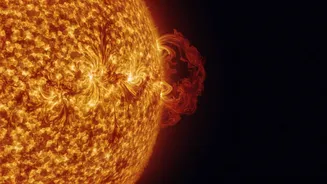
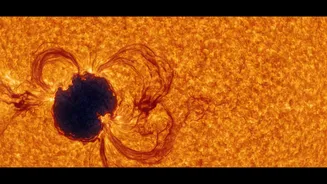
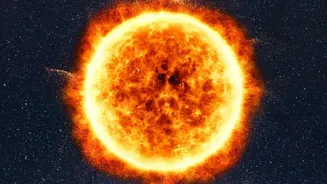
The image reveals a pattern of turbulent, boiling plasma that covers the entire Sun. This landscape is made of cell-like structures, each about the size of Texas, which are the visible signature of convection. In this process, hot plasma from the Sun's interior rises to the surface in the bright center of these cells, cools, and then sinks back down in the dark lanes between them. This gives the surface a granular, textured look, like a pot of boiling water. For the first time, scientists have also directly observed tiny, swirling vortices at the edges of these structures. These whirlpools are signs of a long-theorized phenomenon called the Kelvin-Helmholtz instability, which occurs when fluids or plasmas moving at different speeds slide past each other.
Solving Long-Standing Solar Mysteries
This new level of detail isn't just for show; it's helping scientists tackle some of the biggest questions in solar physics. One major puzzle is the coronal heating problem: why the Sun's outer atmosphere, the corona, is hundreds of times hotter than its visible surface. The newly discovered vortices and other small-scale magnetic phenomena may be a key to the answer. Scientists believe these tiny instabilities could help transfer energy from the surface up into the corona, heating it to millions of degrees. By observing these processes directly, researchers can test their computer simulations and refine their understanding of how energy and magnetism behave on our star.
Improving Space Weather Forecasts
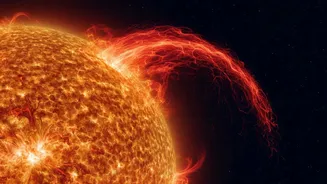
Understanding the Sun's surface is crucial for predicting space weather—the stream of charged particles and magnetic fields that flows from the Sun and can impact Earth. Major events like solar flares and coronal mass ejections (CMEs) originate from intense magnetic activity on the surface. These solar storms can disrupt satellite communications, damage power grids, and pose a risk to astronauts. By studying the Sun's magnetic fields and plasma flows in such fine detail, scientists can better understand the underlying physics that drives these explosive events. The goal is to improve forecasting models, giving us more warning time to protect our technology-dependent society from the effects of a major solar storm.