




A Cosmic Crime Scene
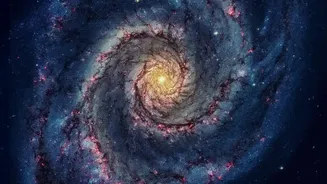
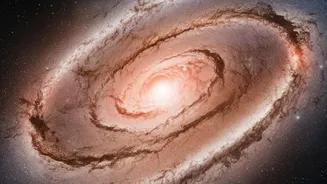
Imagine our galaxy as a vast, spinning spiral, a cosmic frisbee of stars, gas, and dust. For decades, astronomers have worked to understand its structure. Now, a stunning new theory suggests its current orientation is not its original one. Researchers
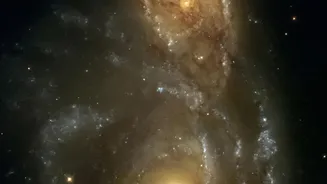
from Durham University, using powerful supercomputer simulations, have found compelling evidence that the Milky Way was struck head-on by a smaller galaxy around 10 to 11 billion years ago. This monumental impact was so powerful that, over hundreds of millions of years, it may have caused the entire disc of the Milky Way to tilt by more than 90 degrees. The discovery was presented at the Royal Astronomical Society's National Astronomy Meeting and helps solve a long-standing puzzle about our galaxy's structure.
The Galactic Bully
The culprit in this ancient drama is a dwarf galaxy known to astronomers as Gaia-Sausage-Enceladus, or the 'Gaia Sausage' for short. This name came about in 2018 when data from the European Space Agency's Gaia mission revealed a group of stars moving in strange, elongated, sausage-like orbits. These stars were the breadcrumbs leading back to the scene of the crime. They are the remnants of the smaller galaxy that was torn to shreds and absorbed by the Milky Way in what is considered the most significant merger in our galaxy's history. Although it was a 'dwarf' galaxy, it was still immense, containing billions of stars and a huge amount of dark matter.
Reading the Stellar Clues
The key to this discovery lies in a mysterious feature of the Milky Way's stellar halo—a vast, sparse sphere of ancient stars that surrounds the main galactic disc. While stars in the disc zip around the galactic centre at about 220 kilometres per second, stars in the halo move much more slowly, at only about 25 kilometres per second. This discrepancy has puzzled astronomers for years. The Durham University team’s simulations showed that such slow-moving halos are a common feature in galaxies that have experienced two key events: a major head-on collision and a subsequent 'disc flip'. By simulating mergers similar to the one with the Gaia Sausage, they found a direct link between the impact and the slow-moving halo, making it a tell-tale sign of the galaxy's violent reorientation.
What 'Flipping' Really Means
The phrase 'flipped on its side' conjures a dramatic, instantaneous image, but the reality was a much more gradual process. It wasn't a sudden somersault but a slow, powerful tilt of the entire galactic disc within its surrounding dark matter halo, likely taking several hundred million years to complete. According to lead researcher Kirill Batrakov, a disc flip is defined as a change in orientation of more than 90 degrees. This means our entire galaxy, including our own solar system's eventual location, was slowly reoriented by the immense gravitational forces unleashed during the merger. This finding also aligns with other research suggesting the Milky Way’s dark matter halo is oriented almost perpendicularly to the stellar disk, a likely consequence of this ancient tilt.
A Galaxy Forged in Chaos
Far from being a static and serene structure, the Milky Way is a dynamic and evolving system built through chaotic mergers. Collisions like the one with the Gaia Sausage are a fundamental part of how large spiral galaxies form and grow. This specific event not only reshaped the galaxy and created its central bulge but also dominated the formation of its stellar halo. The discovery that it also likely flipped the disc on its side adds a dramatic new chapter to the story of our cosmic home. It implies that the path our own Sun takes through the galaxy today might be vastly different from the one it would have taken had this ancient collision never occurred.