

First, A Note on Power: The VEI Scale
To measure the 'power' of a volcanic eruption, scientists use the Volcanic Explosivity Index (VEI). Devised in 1982, it's a logarithmic scale from 0 to 8, meaning each whole number represents an eruption ten times more explosive than the last. The scale considers
the volume of material ejected, the height of the ash cloud, and qualitative observations. A VEI 0 is a gentle, non-explosive lava flow, while a VEI 8 is a mega-colossal super-eruption of the kind that happens perhaps once every 100,000 years. The most powerful eruptions of our century have fallen in the VEI 4 to VEI 6 range—still staggeringly forceful events.
Eyjafjallajökull, Iceland (2010): The Global Grounding
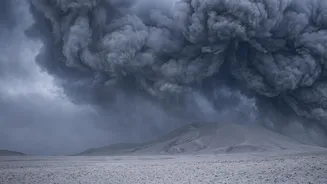
While not the largest eruption scientifically, with a VEI of 4, Iceland's Eyjafjallajökull had an outsized impact. When it erupted in April 2010, the combination of melting glacial ice and magma created incredibly fine, abrasive ash. This ash was then carried by an unusually stable jet stream directly into some of the world's busiest airspace over Europe. Fearing the glass-like particles would destroy jet engines, authorities enacted the largest air-traffic shutdown since World War II. Over an eight-day period, more than 100,000 flights were cancelled, stranding around 10 million passengers and costing the airline industry an estimated $1.7 billion. It was a stark reminder of how a single geological event could bring the modern, interconnected world to a standstill.
Mount Merapi, Indonesia (2010): A Deadly Toll
Just months after Iceland's travel chaos, Mount Merapi in Java, Indonesia, unleashed its largest eruption since the 1870s. Beginning in late October 2010, a series of increasingly violent explosions, rated VEI 4, sent pyroclastic flows—superheated avalanches of gas and rock—scorching down its heavily populated slopes. These flows, along with thick ashfall and volcanic mudflows known as lahars, led to a tragic human cost. Over 350,000 people were evacuated, but more than 350 lives were lost. The eruption destroyed thousands of homes and caused significant disruption, but timely warnings from Indonesian scientists prevented an even greater catastrophe, saving an estimated 10,000 to 20,000 people.
Puyehue-Cordón Caulle, Chile (2011): An Ash Cloud Circles the Globe
In June 2011, after 51 years of inactivity, the Puyehue-Cordón Caulle volcanic complex in Chile roared to life with a massive VEI 5 eruption. It shot a column of ash more than 10 kilometres high, ejecting an estimated one hundred million tons of material—said to be equivalent in power to 70 Hiroshima bombs. The fine ash was swept up by strong winds and blown across the Southern Hemisphere. It caused chaos in nearby Argentine cities like Bariloche, which were coated in a thick, grey blanket. Incredibly, the plume circled the entire globe in about two weeks, disrupting flights in South America, South Africa, Australia, and New Zealand before returning to its origin in Chile.
Hunga Tonga-Hunga Ha’apai, Tonga (2022): An Unprecedented Blast
The eruption of the submarine volcano Hunga Tonga-Hunga Ha’apai on January 15, 2022, was the largest explosive event of the 21st century and the biggest recorded by modern instruments. Rated at least a VEI 5, the blast was heard as far away as Alaska and sent an atmospheric shockwave that circled the planet multiple times. It produced the tallest eruption column ever recorded, soaring an astonishing 57 kilometres into the mesosphere. The underwater explosion displaced a huge volume of water, triggering a devastating tsunami that hit the islands of Tonga with waves up to 20 metres high and radiated across the entire Pacific Ocean, causing damage as far away as Peru. It was a 'magma hammer' event that obliterated an island and sent more water vapor into the stratosphere than any event in recorded history.