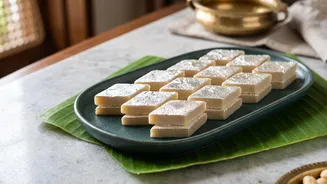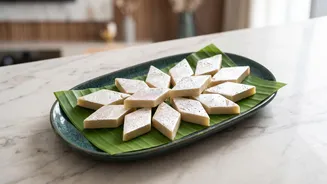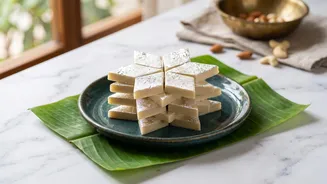


The Essential Ingredients
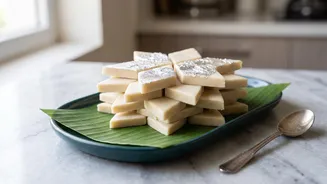
The beauty of Kaju Katli lies in its simplicity, requiring just a handful of core ingredients. You will need about 2 cups of high-quality, raw, unsalted cashews, 1 cup of sugar, and about half a cup of water. A tablespoon of ghee is essential for kneading,
and a pinch of cardamom powder or a few drops of rose water are optional for flavouring. The quality of your cashews is paramount; they should be fresh and moisture-free. If you store them in the fridge, let them come to room temperature before you begin, as cold cashews can release oil when ground.
The Perfect Cashew Powder
The first critical step is transforming the cashews into a fine powder. This is where many first-timers stumble. The goal is a fine, flour-like texture without accidentally making cashew butter. To achieve this, grind the room-temperature cashews in a mixer grinder using short pulses of just a few seconds each. Grinding for too long generates heat and causes the nuts to release their natural oils, resulting in a paste. After grinding, it's a good idea to sieve the powder to remove any larger pieces, which you can then grind again to ensure a uniformly smooth final product.
Mastering the Sugar Syrup
While some recipes use complex syrup consistencies, a simpler approach works just as well. Combine the sugar and water in a heavy-bottomed, non-stick pan over medium heat. Stir until the sugar completely dissolves and let the mixture come to a rolling boil. The key is to create a syrup that is sticky but not overly cooked. A reliable method is the 'one-string consistency' test: after letting a drop cool slightly, it should form a single thin thread when stretched between your thumb and forefinger. Once this stage is reached, you are ready for the next step.
Cooking the Cashew Dough
Turn the heat to low and add the cashew powder to the sugar syrup. Stir continuously and vigorously to prevent lumps from forming and to stop the mixture from sticking to the pan. The mixture will bubble and thicken as the cashew powder cooks. Within minutes, it will start to pull away from the sides of the pan and gather into a single soft, dough-like mass. This is the sign to take it off the heat. Overcooking is a common mistake that results in a dry, crumbly Katli that is difficult to roll. The dough should still be soft when you remove it from the stove; it will continue to firm up as it cools.
Kneading and Rolling
Transfer the hot cashew mixture onto a greased plate or a sheet of parchment paper. Let it cool for just a few minutes until it is warm enough to handle without burning your hands. Do not let it cool completely, as it will become hard and impossible to roll. Add a little ghee and begin to knead the dough gently. Kneading is crucial for a smooth texture, but don't overdo it, as excessive pressure can cause the cashews to release oil. Knead for a few minutes until the dough is smooth and supple, not sticky. Then, place another sheet of parchment paper on top and roll the dough to a uniform thickness of about a quarter-inch.
Troubleshooting Common Issues
If your mixture turns out sticky, it's likely undercooked. You can return it to the pan for a few more minutes of cooking on low heat or try adding a teaspoon of milk powder to help absorb excess moisture. If the dough is too dry and crumbly, it was probably overcooked. You can try to salvage it by kneading in a few drops of warm milk or ghee to add moisture back. If your cashews become oily and paste-like during grinding, you can add a tablespoon of sugar to the grinder to help absorb some of the oil. Getting the right texture often takes practice, so don't be discouraged.