







A World Frozen in Time?
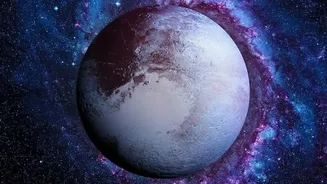
For decades, Pluto was seen as a distant, static ball of ice and rock, a relic frozen solid billions of years ago. At nearly 6 billion kilometres from the Sun, its surface temperatures plummet to around minus 230 degrees Celsius. At that temperature,
familiar gases like nitrogen and methane become solid ice, blanketing the dwarf planet. For this reason, scientists long assumed Pluto was geologically dead. The idea of liquid flowing on its surface seemed preposterous. Any warmth from its formation should have radiated away long ago, and with no large nearby planet to gravitationally flex its interior, there seemed to be no engine to drive geological activity. That all changed in 2015.
The New Horizons Surprise
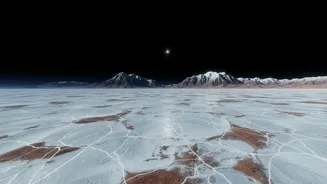
When NASA’s New Horizons spacecraft flew past Pluto, it sent back images that stunned the scientific community. Instead of a uniformly cratered and ancient surface, it revealed towering mountains of water ice, vast plains of frozen nitrogen, and surprisingly few impact craters in certain areas. A lack of craters implies a young surface, one that is being actively reshaped. The most famous of these features is Sputnik Planitia, the western lobe of Pluto's iconic heart-shaped region. This enormous basin, larger than Texas and Oklahoma combined, is filled with nitrogen ice that appears to be slowly churning in giant convection cells, like a planetary-scale lava lamp. This was the first major clue that Pluto was far from dead.
Why Rain is Impossible
The dark streaks and patches on Sputnik Planitia looked uncannily like features on Earth’s glaciers that have been wetted by water. But on Pluto, rain as we know it—or even rain made of nitrogen—is physically impossible. Its atmosphere is incredibly thin, about 100,000 times less dense than Earth's, and far too cold to support the kind of weather cycle that leads to precipitation. Any liquid exposed to that environment would flash-freeze or sublimate into gas almost instantly. So if the liquid wasn't coming from the sky, scientists had to look for another source: underground.
The Cryovolcano Theory
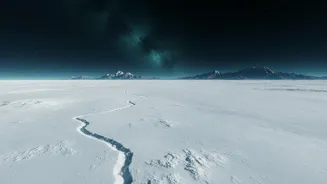
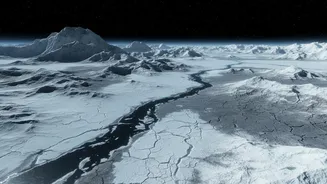
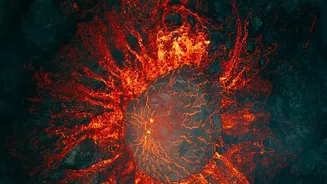
The leading explanation is a phenomenon known as cryovolcanism—ice volcanoes. Instead of spewing molten rock, cryovolcanoes erupt a cold, slushy mixture of water, nitrogen, ammonia, and methane. Heat from Pluto's rocky core, generated by the slow decay of radioactive elements, could be just enough to melt some of the ices in its interior. Some research suggests a layer of ammonia mixed with water acts as an antifreeze, allowing a liquid ocean to exist beneath Pluto's thick ice shell. More recent studies point to liquid nitrogen. The immense pressure at the base of the kilometres-deep Sputnik Planitia glacier could be sufficient to melt the nitrogen ice, which then becomes buoyant. This liquid nitrogen could then well up through cracks and fissures in the surface, flowing briefly before refreezing. This process could explain the dark, wetted-look features observed by New Horizons, providing the first evidence of recently flowing liquid on Pluto.
A New View of Distant Worlds
The discovery that Pluto is, or was very recently, geologically alive has profound implications. It challenges our understanding of how and where planetary activity can occur. The presence of features like Wright Mons, a massive mountain with a central depression that strongly resembles a shield volcano, suggests that cryovolcanic eruptions have been happening on a massive scale for a long time. This activity shows that a world doesn't need to be close to a star or have a large moon to have a warm, active interior. The right mix of materials and internal radioactive heating might be all that's required. This raises the tantalizing possibility that other large objects in the distant Kuiper Belt could also be geologically active, perhaps even harbouring their own subsurface oceans.