

A Universe Full of Mystery
In the late 1990s, astronomers studying distant supernovae discovered something startling: the expansion of the universe isn't slowing down, it's speeding up. This acceleration goes against everything we thought we knew about gravity, which should be
pulling the cosmos back together. To explain this observation, scientists proposed the existence of a mysterious, repulsive force that makes up about 68% of the entire universe. They named it dark energy. Despite it being the dominant component of the cosmos, its true nature remains completely unknown. Is it a constant energy inherent to the vacuum of space, or something else entirely? Answering this question is fundamental to understanding the past, present, and ultimate fate of our universe.
Meet NASA’s New Cosmic Cartographer
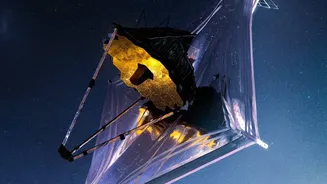
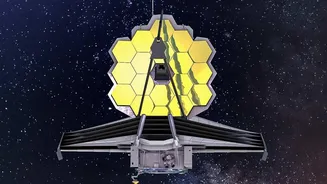
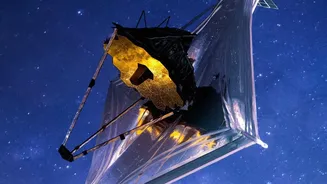
Enter the Nancy Grace Roman Space Telescope, which successfully launched in August 2026. Named after NASA's first chief of astronomy, this next-generation observatory is a technological marvel designed for cosmic cartography. While its primary mirror is the same size as the Hubble Space Telescope's, its key innovation is an enormous field of view. The Roman's Wide Field Instrument can see an area of the sky 100 times larger than Hubble's infrared camera in a single snapshot. Think of Hubble as a zoom lens, perfect for detailed close-ups, while Roman is the wide-angle lens, built to capture vast, panoramic vistas of the cosmos. This capability makes it the perfect tool for conducting the massive surveys needed to hunt for clues about dark energy.
The Survey Strategy
Roman's primary mission to tackle dark energy is the High Latitude Wide Area Survey (HLWAS). This ambitious project will map an enormous section of the sky—about 12% of it—over its five-year primary mission. To put that in perspective, all of Hubble's observations over more than 30 years have covered less than 1% of the sky. The HLWAS will meticulously measure the positions, shapes, and distances of hundreds of millions of galaxies. This enormous dataset will allow scientists to create the largest-ever 3D map of the universe, providing a new level of precision to study its structure and evolution through cosmic time.
Cosmic Clues and Standard Rulers
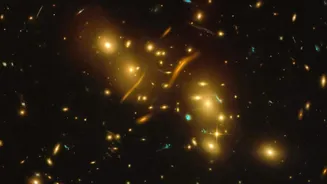
So how does mapping galaxies reveal the secrets of dark energy? Roman will employ three main techniques. First is weak gravitational lensing. The telescope will measure how the light from distant galaxies is subtly distorted by the gravity of all the matter—including dark matter—that it passes on its way to us. This will create a map of dark matter and show how dark energy affects the growth of cosmic structures. Second, Roman will hunt for thousands of Type Ia supernovae, exploding stars that act as 'standard candles' because they all have a consistent brightness. By measuring their apparent faintness, astronomers can gauge their distance and calculate the expansion rate of the universe at different times. Finally, the telescope will measure Baryon Acoustic Oscillations (BAO), which are the faint, ripple-like imprints of sound waves from the early universe that are now frozen into the large-scale distribution of galaxies. These ripples provide a 'standard ruler' to measure cosmic distances and track the history of expansion with incredible accuracy.
More Than a One-Trick Pony
While unraveling the mystery of dark energy is its headline act, the Roman Space Telescope is a versatile observatory with a broad scientific agenda. Its massive surveys will create a treasure trove of data that will benefit nearly all areas of astrophysics. One of its other primary goals is to conduct a census of exoplanets using a technique called gravitational microlensing. This method can detect planets that are much farther from their star than other techniques allow, including free-floating 'rogue' planets that don't orbit a star at all. The mission is expected to discover thousands of new worlds, providing crucial insights into how planetary systems form and evolve.