


A Glimpse into the Early Universe
Imagine looking so far away that you're actually looking back in time. That’s what an international team of astronomers did using the James Webb Space Telescope. They pointed it at a galaxy named J0148-4214, so distant that its light has taken 12.5 billion
years to reach us. This means we are seeing this galaxy as it was just 1.2 billion years after the Big Bang, offering a rare snapshot of the universe in its infancy. What they found there challenges our understanding of how galaxies and the monsters within them grow. Inside this single, ancient galaxy, they detected the telltale signs of three supermassive black holes actively feeding on surrounding gas and dust. It’s the first time such a trio has been confirmed in the distant universe.
Cosmic Monsters and Their Appetites
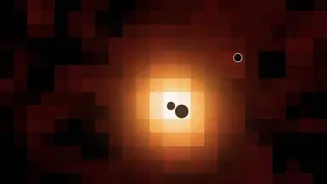
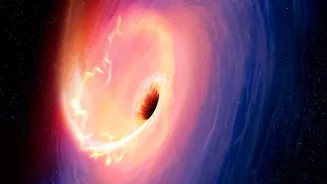
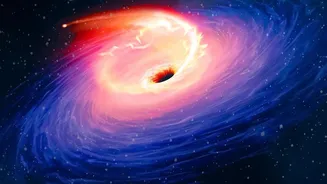
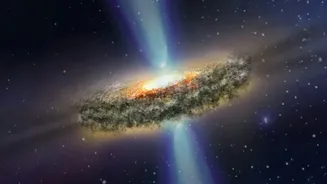
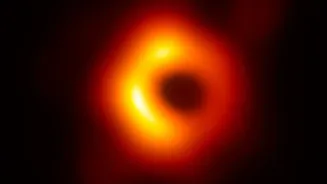
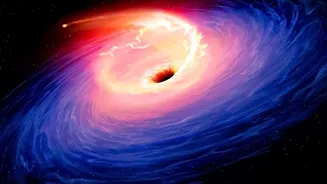
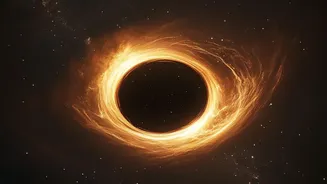
Supermassive black holes are the titans of the cosmos, objects with masses millions or even billions of times that of our sun. We believe one sits at the heart of nearly every large galaxy, including our own Milky Way. When these black holes are actively pulling in matter—a process called accretion—the material heats up and glows brightly, particularly in X-rays, allowing telescopes to spot them from across the universe. The discovery in J0148-4214 revealed three such active black holes. Two are nestled close together near the galaxy's center, separated by only 620 light-years. A third lurks further out, about 5,500 light-years from the central pair. Their masses are staggering: the largest is about 80 million times the mass of our sun, its companion is about 600,000 solar masses, and the third is around 2 million solar masses.
Why Finding Three is a Big Deal
So, why is this discovery so exciting for scientists? A leading theory of galaxy evolution suggests that galaxies grow by merging with one another. When this happens, their central supermassive black holes are expected to sink toward the center of the newly formed, larger galaxy, eventually merging themselves. Finding a triple system provides powerful evidence for this chaotic process. It suggests that in the crowded, busy environment of the early universe, such mergers were common and efficient at bringing black holes together. This offers a solution to a long-standing puzzle: how did supermassive black holes get so enormous, so quickly? While they can grow by steadily consuming gas, merging with other black holes provides a much faster route to gigantic sizes.
A Future Cosmic Collision
The two black holes at the center of J0148-4214 are on a collision course. While it won't happen overnight—they are expected to merge in a few hundred million years—this system provides a living laboratory for what happens in the final stages of a galactic merger. According to Hannah Übler of the Max Planck Institute for Extraterrestrial Physics, who led the study, this discovery helps set the stage for what future gravitational-wave observatories might detect. When these behemoths finally combine, they will send powerful ripples through the fabric of spacetime, known as gravitational waves. As for the third black hole, its future is less certain. It could be the remnant of a previous merger or it could eventually join the central dance, but for now, it remains a captivating part of this unique cosmic family.