



What Exactly Are Ghost Particles?
These so-called 'ghost particles' are actually neutrinos. They are fundamental subatomic particles, much like electrons, but with some very peculiar properties. They have almost no mass and no electrical charge, which means they barely interact with the world
around them. While light can be blocked by a wall, a neutrino can fly through an entire planet as if it were empty space. Billions of them, mostly from our sun, are streaming through your body right now without you ever noticing. This elusive nature makes them incredibly difficult to detect, but it also makes them perfect cosmic messengers. Because they travel unimpeded from their source, they carry pristine information about the violent cosmic events that created them, like exploding stars or the churning hearts of distant galaxies.
The Hunt for a Cosmic Source
For years, physicists have been trying to pinpoint where the most energetic of these neutrinos come from. Giant detectors, like the IceCube Neutrino Observatory buried deep in the Antarctic ice, were built specifically for this purpose. IceCube uses a cubic kilometre of ice, studded with thousands of sensors, to watch for the faint flashes of light produced when a neutrino, by pure chance, collides with an atom. Previously, scientists found strong evidence linking some high-energy neutrinos to blazars—galaxies with supermassive black holes at their centres that shoot out powerful jets of matter. One such source is the active galaxy NGC 1068. But these known sources could not account for all the high-energy neutrinos IceCube was detecting, suggesting another type of cosmic accelerator was still out there, hiding.
A New Suspect: Starburst Galaxies
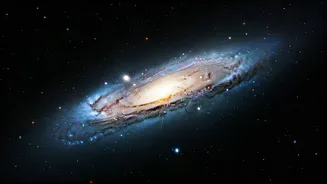
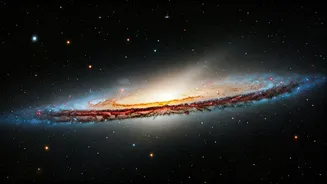
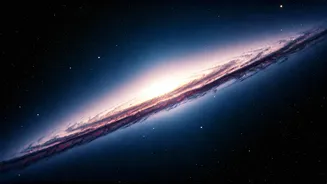
Recent findings have now pointed the finger at a new class of objects: star-forming galaxies, often called 'starburst' galaxies. These are galaxies undergoing an incredibly intense and rapid period of star formation, creating new stars at a rate hundreds of times faster than our own Milky Way. These galaxies are cosmic construction zones, filled with dense clouds of gas and dust where massive stars are born. These young, massive stars live fast and die young, exploding as supernovae. The combined chaos of stellar winds and supernova shockwaves creates a turbulent environment that acts as a natural particle accelerator. Theoretical models have long predicted that these dense, violent regions could be powerful neutrino factories.
The 'Shadow Blaster' Breakthrough
A breakthrough came with the detection of a single high-energy neutrino, catalogued as IC 210922A, in September 2021. After the alert from IceCube, astronomers around the world scrambled to find its source, but initial searches for a bright, obvious counterpart like a black hole jet came up empty. A dedicated team, however, looked at the region with telescopes that can see in longer wavelengths, piercing through cosmic dust. They found a compelling candidate: a distant, dust-shrouded star-forming galaxy nicknamed 'Shadow Blaster', located about 11 billion light-years away. Crucially, this galaxy showed no signs of an active supermassive black hole at its centre. This suggests that the intense star-forming activity alone was enough to generate the powerful neutrino.
A New Window on the Universe
This discovery, if confirmed, is a major step forward for neutrino astronomy. It provides the first strong evidence directly linking a high-energy neutrino to an individual star-forming galaxy. It suggests that these types of galaxies, which were much more common in the early universe, could be a significant and previously overlooked source of the cosmic neutrinos that rain down on Earth. Researchers estimate that this population of dusty, active galaxies could be responsible for up to 20% of the unexplained neutrino background detected by IceCube. By studying neutrinos from these sources, we can peer into the obscured hearts of the universe's most extreme stellar nurseries, opening a new 'multi-messenger' window to understand the cosmos.