


A Clear and Present Danger
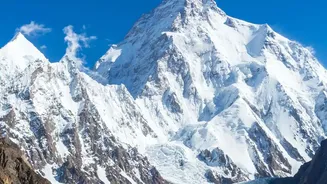
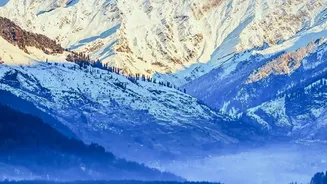
The Himalayas, often called the 'Third Pole', are home to the largest volume of ice outside the polar regions. This ice feeds Asia's great rivers, including the Ganga, providing water for hundreds of millions of people. But as global temperatures rise,
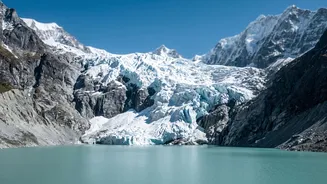
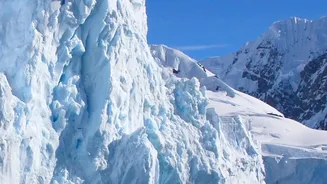
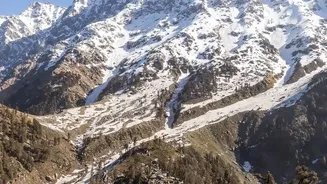
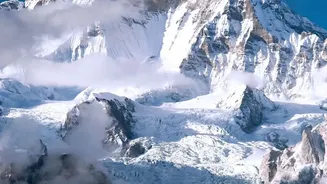
this critical water tower is facing a crisis. A recent study has identified 219 unstable 'hanging glaciers' in the Alaknanda basin alone. These are massive ice bodies perched precariously on steep mountain slopes. Unlike valley glaciers that flow downwards, these can break off without warning. The study, published in a 'Nature' journal, highlights that nearly a third of this unstable ice is concentrated in the Upper Alaknanda basin, a region already known for its seismic activity and home to key pilgrimage sites and infrastructure.
The Science of Instability
Researchers have found that Himalayan glaciers are becoming increasingly unstable due to rapid warming and changing precipitation patterns. The warming, which exceeds the global average, is causing glaciers to retreat at an accelerated pace of 10-15 meters per year. This leads to the development of these unstable hanging glaciers. The study in the Alaknanda basin used simulations to understand the potential impact of a collapse. The findings are alarming: an avalanche from one of these glaciers could create a flow of rock and ice over 50 metres high, capable of overwhelming settlements and critical infrastructure like National Highway 7. The Wadia Institute of Himalayan Geology has confirmed that climate change is the primary factor, causing repeated freezing and thawing that fractures the ice over time.
The Specter of GLOFs
One of the most significant secondary threats from these unstable glaciers is the creation of Glacial Lake Outburst Floods, or GLOFs. As glaciers melt, water often accumulates behind natural dams made of loose rock and sediment (moraine). A large chunk of ice breaking off a hanging glacier can fall into one of these lakes, causing a massive displacement wave that breaches the dam. The result is a sudden, catastrophic flood downstream. This is not a theoretical risk; such events have caused devastation across the Himalayas. The 2021 Chamoli disaster, which involved a glacier collapse, served as a stark reminder of the destructive power of these cascading hazards. The increased formation and expansion of glacial lakes across the Himalayas mean the risk of GLOFs is rising, threatening communities and vital infrastructure like hydropower plants.
A Future of Increased Risk
The study's projections paint a grim picture for the coming years. By 2030, the land area occupied by buildings and infrastructure vulnerable to these avalanche hazards is expected to be 120% higher than it was in 2000. During the same period, the population living in these exposed areas is projected to increase by 17%. This isn't just about flood risk; it's about India's long-term water and energy security. The Himalayan glaciers feed rivers that are the lifeblood for over 500 million people and support 37% of India's irrigated land. While melting might temporarily increase river flows, the long-term reduction in glacier mass threatens to severely reduce water availability, especially during the dry season.
The Call for Action
The study underscores an urgent need for proactive measures. Unlike the European Alps, which have extensive surveillance, the Himalayas suffer from a significant monitoring gap. Experts are calling for the systematic identification and continuous monitoring of high-risk glaciers, especially in densely populated or strategic areas like the Alaknanda basin. This includes using technologies like radar and time-lapse cameras to create robust early-warning systems. Furthermore, the findings highlight the necessity of incorporating these hazard assessments into all land-use planning and infrastructure development. Limiting risks for downstream communities will require a coordinated effort between scientific bodies, disaster management agencies, and policymakers to build resilience against a changing climate.