


Our Galactic Neighbor
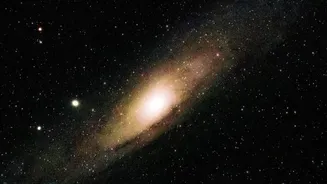
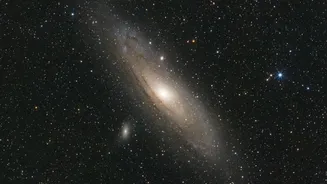
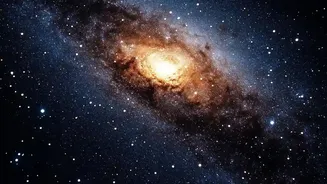
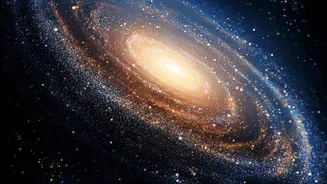
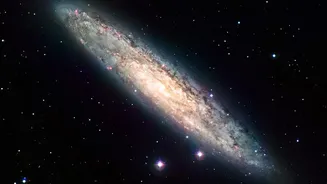
At 2.5 million light-years away, the Andromeda galaxy, or M31, is the closest major spiral galaxy to our own Milky Way. It is so close that on a clear, dark night, it's visible as a faint, fuzzy patch to the naked eye. Because of its proximity and its similar
size to the Milky Way, Andromeda offers a unique opportunity for study. It allows us to look at another galaxy with incredible detail, providing an external perspective that's impossible to get from within our own. Studying Andromeda is like looking at a sibling to better understand yourself.
The Stellar Fossil Record
To understand a galaxy's history, astronomers practice a form of cosmic archaeology. The key is that stars act as a 'fossil record'. Their color, brightness, and mass reveal when they were born. Massive, hot stars burn bright blue but live short lives, indicating recent star formation. Smaller, cooler stars live much longer, preserving the history of ancient star-making events. By cataloging millions of individual stars, scientists can build a detailed timeline of how, when, and where a galaxy has been active. This is precisely what a new study, using years of Hubble data, set out to do for Andromeda.
Hubble's Unprecedented Deep Dive
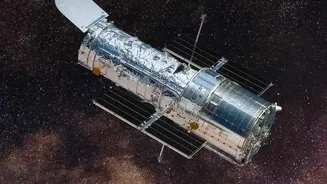
The study is a monumental achievement, combining two massive Hubble observation programs: the Panchromatic Hubble Andromeda Treasury (PHAT) and its southern counterpart, PHAST. Together, they created a gigantic, high-resolution map covering about two-thirds of Andromeda's sprawling disk, resolving roughly 200 million individual stars. According to Ben Williams, a study co-author, Hubble is the only telescope capable of providing the necessary resolution over such a large area to make this kind of galactic history legible.
A Story of Decline
The data tells a clear story: Andromeda is slowing down. Astronomers already knew the galaxy had a major burst of star formation about two billion years ago, possibly from a galactic merger. The new analysis shows what happened next. Around 500 million years ago, Andromeda was forming stars at a rate of about one solar mass per year—similar to the Milky Way. But since then, it's been on a steady decline. The rate dropped by half by 40 million years ago, and today it has plummeted to just one-fifth of a solar mass per year. The most dramatic drop-off has occurred in the last 40 million years.
The Prime Suspect
This slowdown isn't happening uniformly. Most of the decline is concentrated in a large, star-forming ring of gas and dust about 32,000 light-years from the galaxy's center. But what's causing it? One leading theory points to a small satellite galaxy, M32, which orbits Andromeda. The slowdown in star birth is especially pronounced on the side of Andromeda closest to M32, starting around 60 million years ago. While astronomers can't yet prove causation, lead author Tobin Wainer calls M32 "the most likely suspect." It’s possible that a past interaction with M32 disrupted the gas in Andromeda's disk, leading to its current quiet phase.
A Glimpse into the Future
Understanding Andromeda's past helps us understand the life cycle of large spiral galaxies and even provides a preview of our own distant future. The Milky Way and Andromeda are on a collision course, set to merge in about 4.5 billion years, an event that will trigger a massive burst of new star formation. Studying Andromeda's more quiescent state after its own past merger gives us vital clues about how galaxies evolve from active, star-making machines into quieter, more settled systems. The upcoming Nancy Grace Roman Space Telescope will continue this work, using its wider field of view to gain an even more complete picture of our cosmic neighbor's history.