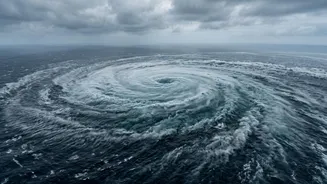








As cyclones brew over the Indian Ocean, a critical question arises: where will they go and how strong will they get? Forecasters are now looking to the past for answers, using decades of storm data to teach computers to see the future.
The Challenge of Cyclone Forecasting
Predicting the behaviour
of a tropical cyclone is one of meteorology's toughest challenges. These powerful storms are complex, dynamic systems influenced by a dizzying array of factors, from sea surface temperatures to upper-level wind patterns. A slight change in any one of these variables can drastically alter a cyclone's path and intensity, making the difference between a near-miss and a catastrophic landfall. For decades, forecasters relied on physics-based numerical weather prediction (NWP) models. These models use current atmospheric conditions and the fundamental laws of physics to simulate how a storm might evolve. While these have grown increasingly sophisticated, they can be computationally expensive and have limitations, especially in predicting rapid intensification.
Mining the Past for Clues
This is where historical data comes in. Every cyclone that has ever been recorded leaves behind a data trail. This includes its track, changes in wind speed, central pressure, and the surrounding atmospheric and oceanic conditions. Archives like the International Best Track Archive for Climate Stewardship (IBTrACS) contain comprehensive global data on thousands of storms, some dating back to 1979. This vast library of past events is a goldmine for modern forecasting. By analysing this data, scientists can identify recurring patterns and relationships between specific environmental conditions and how a storm behaves. It allows them to 'train' new types of predictive models to recognise the tell-tale signs of a storm that is about to strengthen or change direction.
Inside the WeatherNext Engine
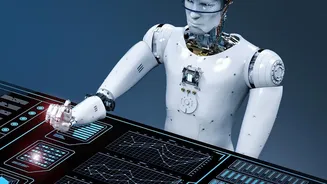
Companies and research groups are developing advanced AI models, which we can call 'WeatherNext' for this purpose, that use machine learning to digest these enormous historical datasets. The process starts by feeding the model data from thousands of past cyclones. The AI learns to connect specific initial conditions—like ocean heat content, wind shear, and atmospheric pressure fields—to the eventual outcome of the storm. Unlike traditional models that are bound by programmed physics equations, these AI systems learn the patterns directly from the data itself, capturing subtle, non-linear relationships that older methods might miss. They can process vast amounts of information much faster, running thousands of simulations to generate a range of possible outcomes. This is known as 'ensemble forecasting', where instead of one single predicted track, forecasters get a 'spaghetti plot' of possibilities, along with probabilities for each one.
From Data to Actionable Warnings
The output of a model like WeatherNext isn't just a line on a map; it's a rich set of probabilistic forecasts. For agencies like the India Meteorological Department (IMD), this information is invaluable. The IMD uses a combination of different models, including its own, as well as those from international centres, to create a consensus forecast. The use of these advanced techniques and multi-model ensembles has significantly improved the accuracy of cyclone warnings in India. These AI-driven insights help forecasters issue more precise warnings about the timing of landfall, expected wind speeds, and potential storm surge. This allows disaster management authorities to make better decisions about evacuations, resource deployment, and public advisories, ultimately saving lives and property.
The Future is Human and Machine
While AI is revolutionising weather prediction, it is not replacing the human expert. The most effective approach is a collaboration between machine and meteorologist. The AI can rapidly analyse complex data and run scenarios, but human forecasters bring intuition, experience, and the ability to account for unique local factors that a model might overlook. As AI models become more powerful, they will function as an incredibly sophisticated tool, providing forecasters with deeper insights and greater confidence in their predictions. The integration of AI-based systems with traditional numerical models is already underway, promising a future where cyclone warnings are even more timely and accurate, helping communities across India become more resilient to these powerful natural threats.