







A Strategic Shift in Space Policy
For decades, the Indian Space Research Organisation (ISRO) has been the sole custodian of the nation's space assets. However, a series of transformative policy reforms, culminating in the Indian Space Policy 2023, is fundamentally reshaping this paradigm.
The government is now actively transferring the operational control of critical infrastructure to private companies. This move is facilitated by the Indian National Space Promotion and Authorisation Centre (IN-SPACe), a single-window agency created in 2020 to promote, authorise, and supervise private sector participation in all space activities. The goal is to move from a supply-driven model, where ISRO dictated capabilities, to a demand-driven one where the market and private innovation play a leading role.
What Infrastructure Is Being Opened Up?
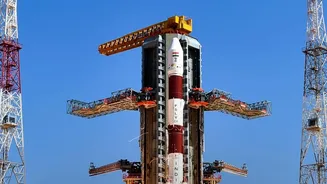
The scope of this privatisation is extensive. A landmark example is the recent move by IN-SPACe to hand over the complete operations and management of the new Rs 986-crore Small Satellite Launch Complex (SLC) at Kulasekarapattinam in Tamil Nadu. Instead of just allowing private companies to launch from the facility, a private entity will be responsible for its end-to-end management, from maintenance and safety to mission readiness and logistics. Beyond launchpads, IN-SPACe is also opening up access to ISRO’s ground infrastructure, inviting private firms to establish and operate ground stations at key facilities like the National Remote Sensing Centre (NRSC) campus. Furthermore, the government has begun transferring the technology for its workhorse rockets, including the Polar Satellite Launch Vehicle (PSLV) and the heavy-lift LVM3, to enable private manufacturing and commercial launch services.
The ‘Why’ Behind the Change
This strategic pivot is not an admission of weakness but a calculated move to unleash India's full potential in the global space economy. The primary objective is to free up ISRO from routine operational tasks and allow the premier agency to focus its resources on what it does best: pioneering research and development, deep-space exploration, and strategic missions like human spaceflight (Gaganyaan) and building a future Indian space station. By letting private enterprise handle the established, commercial aspects of space, ISRO can concentrate on pushing the frontiers of science and technology. This division of labour is seen as essential for accelerating innovation and capturing a larger share of the burgeoning global space market.
Fueling a Multi-Billion Dollar Economy
The economic ambitions are significant. India's space economy, valued at around $8.4 billion, currently accounts for only 2% of the global total. Through these reforms, the government aims to grow this to $44 billion by 2033, increasing India's global market share substantially. To catalyse this growth, IN-SPACe is implementing schemes that offer subsidies ranging from 30% to 100% on launch services, technology transfer fees, and access to ISRO facilities and data. These incentives are designed to lower the high entry barriers for startups and make Indian space businesses more competitive on the world stage. The policy has already spurred a vibrant ecosystem, with over 200 spacetech startups emerging since 2020.
Opportunities and the Road Ahead
Handing over complex and sensitive space infrastructure comes with challenges, including ensuring a smooth transition, maintaining stringent safety and security standards, and navigating the talent migration from the public to the private sector. To ease the handover, ISRO will provide initial technical guidance and training to the selected private operators. The move is expected to create thousands of high-skilled jobs and drive innovation across related sectors like agriculture, telecommunications, and disaster management. Ultimately, the success of this public-private model will be tested at facilities like the Kulasekarapattinam spaceport, which could become a blueprint for how India manages its space assets in the 21st century. The message is clear: India is not just opening its space sector, but building an integrated ecosystem where private industry is a core partner in its national ambitions.