


More Than Just a Walk with Poles
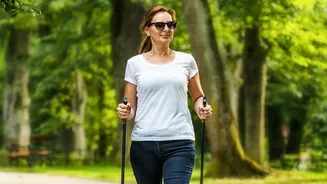
Originating in Finland as a summer training method for cross-country skiers, Nordic walking transforms a regular walk into a comprehensive workout. It involves using specially designed poles to propel yourself forward, engaging your upper body in a way
that normal walking doesn't. While it might look like hiking with trekking poles, the technique is fundamentally different. The goal isn't just to aid balance but to actively use the poles to engage muscles in your arms, shoulders, chest, and core. This turns a lower-body activity into a session that utilizes 80% to 90% of your body's muscles, compared to just 50% with standard walking.
The Full-Body Benefits
The secret to Nordic walking’s effectiveness lies in its ability to combine cardiovascular exercise with a muscle workout. Studies show it can burn up to 46% more calories than walking at the same pace. This increased effort also leads to a higher heart rate and oxygen consumption. Beyond calorie burn, the benefits are extensive. It improves posture, strengthens the upper body and core, and enhances balance and coordination. Because the poles help absorb impact, it's significantly gentler on the joints—especially knees and hips—than running, making it an excellent option for those with joint concerns or those in rehabilitation. Research has also linked it to reductions in chronic pain, anxiety, and 'bad' cholesterol.
Getting the Technique Right
Mastering the basic Nordic walking technique is key to unlocking its benefits. The fundamental movement is based on a natural walking rhythm with an opposite-arm, opposite-leg motion. As your left leg steps forward, your right arm swings forward with the pole. The key is to plant the pole behind you at an angle, hold the grip firmly as you plant, and then open your hand to push off through the strap as your arm swings back. This push-off is what propels you forward and engages your upper body muscles. Maintaining an upright posture with a slight forward lean from the ankles is crucial. The movement should feel fluid, originating from the whole body rather than just the arms.
Scaling for Your Fitness and Balance
One of the greatest advantages of Nordic walking is its scalability. Beginners can start on flat, even surfaces like sidewalks, focusing on mastering the coordination between their arms and legs. The initial goal is to find a comfortable rhythm and build confidence. As balance and conditioning improve, you can increase the intensity. This doesn't mean you have to start running. Instead, you can walk faster, tackle hills and varied terrain, or increase the force of your push-off from the poles to demand more from your cardiovascular system and muscles. Advanced walkers can achieve speeds of 7 to 9 km/h, turning their walk into a high-performance endurance session purely by refining their technique and power.
Intensity Without the Impact
The claim that Nordic walking can raise intensity without becoming a run is well-supported. The impact force of running is about 2.5 to 3.5 times your body weight with each step. For Nordic walking, it's only about 1.0 to 1.3 times, similar to a brisk walk. Yet, because you're engaging so many more muscles, the cardiovascular benefits can be comparable to those of a moderate-intensity jog. This unique combination allows you to elevate your heart rate into a beneficial training zone while sparing your joints from repetitive, high-impact stress. It offers a sustainable way to build and maintain fitness over the long term, reducing the risk of injuries that can sideline runners.
Choosing the Right Equipment
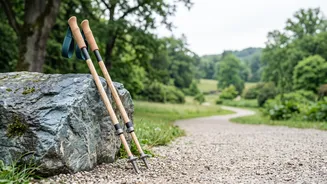
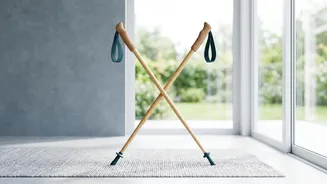
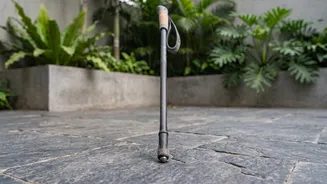
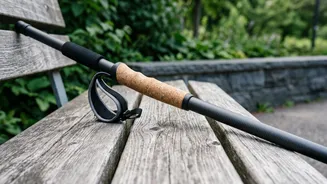
It's essential to use poles specifically designed for Nordic walking, not trekking poles. The key difference is the strap. Nordic walking poles feature a glove-like strap or gauntlet that allows you to release your grip on the handle as your arm swings back, pushing through the strap to generate power. Trekking poles have a simple loop designed to prevent you from dropping the pole and are meant to be held continuously. Nordic walking poles are also typically lighter and have slanted rubber 'paws' on the tips for use on hard surfaces, which facilitate the correct backward-angling technique.