






Meet the Habitable Worlds Observatory
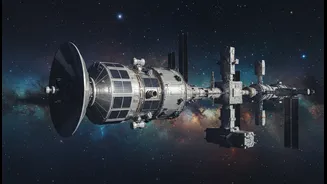
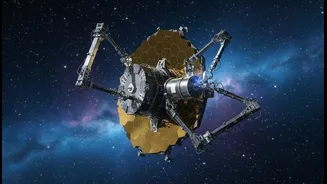
Slated for launch in the 2040s, NASA's next great eye on the cosmos is the Habitable Worlds Observatory (HWO). This flagship mission has a singular, profound goal: to become the first telescope designed specifically to find and analyze Earth-like planets
orbiting stars like our sun, searching their atmospheres for chemical hints of life. It aims to directly image at least 25 potentially habitable worlds. To do this, it will need to be about 100 times more stable than the James Webb Space Telescope (JWST), capable of blocking a star's glare by a factor of 10 billion to see the faint glimmer of a planet next to it. It’s an extraordinary technological challenge, but NASA is building an equally extraordinary new philosophy into its very blueprint.
The Lessons of Hubble
To understand why HWO's design is so revolutionary, we have to look back at the Hubble Space Telescope. Launched in 1990, Hubble was famously designed to be serviced by astronauts. This proved critical when a flaw in its main mirror was discovered, which was heroically corrected by a Space Shuttle crew in 1993. Over five servicing missions, astronauts not only repaired Hubble but also upgraded its instruments, dramatically extending its life and scientific power. These missions made Hubble an icon, but they were only possible because it operates in low-Earth orbit, within reach of the Space Shuttle. For NASA's next generation of observatories, that's a luxury they can no longer afford.
A Bridge Too Far for Astronauts
Like the James Webb Space Telescope, the Habitable Worlds Observatory is destined for a lonely post about 1.5 million kilometres (1 million miles) from Earth at a location called the second Lagrange point, or L2. This gravitationally stable spot is ideal for astronomy, offering clear, uninterrupted views of the universe. However, it is far beyond the reach of any crewed spacecraft currently in operation. Sending astronauts to L2 for a repair mission would be an unprecedented, high-risk, and incredibly expensive undertaking. If something were to go wrong with HWO—a stuck component, a degraded sensor, or even damage from a micrometeoroid—a human helping hand would not be on the way. This is why NASA has mandated that serviceability must be designed into the mission from day one, but with a twist.
Enter the Robots
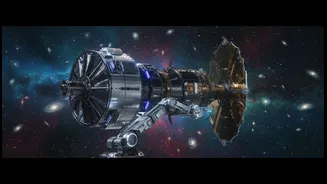
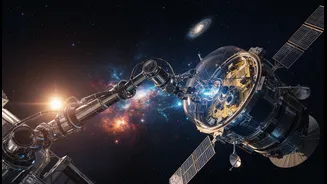
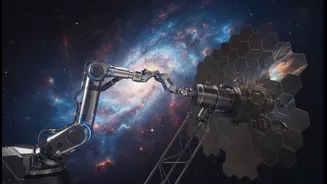
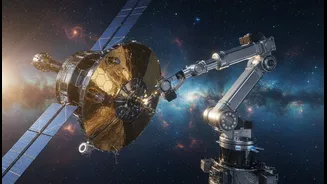
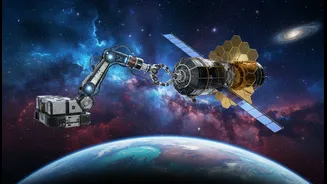
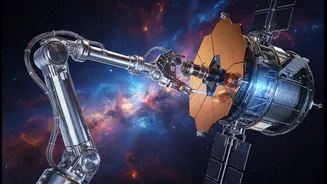
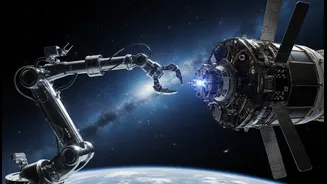
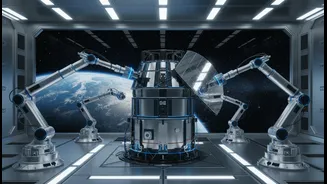
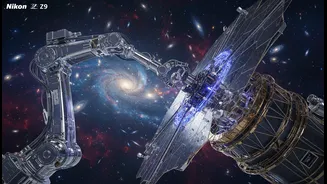
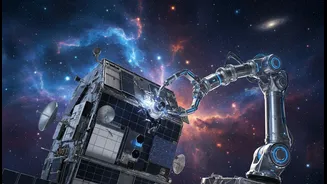
Instead of astronauts, HWO will be tended to by robotic spacecraft. The entire observatory is being designed with a modular architecture, featuring standardized, line-replaceable units. Think of it like a sophisticated set of LEGO bricks. Critical systems, computers, and scientific instruments will be built as modules that can be easily unplugged and swapped out by a robotic servicer. These future service missions, likely operated by commercial partners, would involve a robotic craft flying to the telescope, latching on, and performing complex repairs, maintenance, and even upgrades. This new approach not only mitigates the risk of a single point of failure ending an $11 billion mission, but it also turns the telescope into an evolving, sustainable platform for discovery.
Designing for the Future
By making HWO robot-repairable, NASA is future-proofing its investment. It allows the agency to extend the observatory’s life far beyond its initial mission, just as servicing did for Hubble. More importantly, it allows the telescope to evolve. As detector technology improves on Earth, a robotic servicer could one day deliver and install a brand-new, more powerful scientific instrument, keeping HWO at the cutting edge of science for decades. This approach represents a paradigm shift, moving away from single-use, monolithic observatories towards sustainable, upgradable infrastructure in space. It's a strategy that not only maximizes the scientific return but also provides a powerful driver for the growing commercial industry of in-space servicing.