


The Evening Star’s Big Night
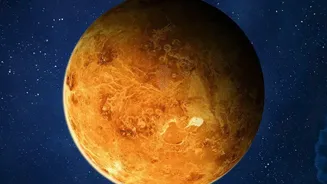
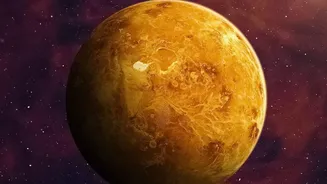
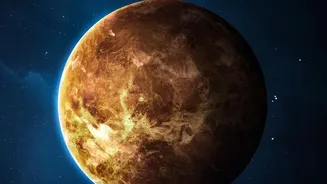
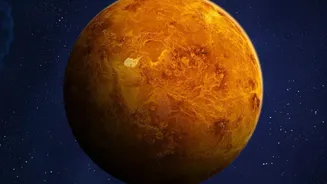
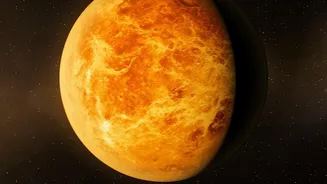
Often called the “Evening Star” or “Morning Star,” Venus has captivated sky-gazers for millennia. It is, after the Moon, the brightest natural object in our night sky. Its brilliance isn't due to its own light, but the result of its dense, highly reflective
clouds bouncing sunlight back at us. This August, Venus is putting on a special show. Throughout the month, it has been a dazzling presence in the western sky just after sunset. The celestial performance reaches a key moment on August 15, 2026, a date astronomers have marked as its 'greatest eastern elongation'. This event provides an excellent chance to appreciate our planetary neighbour, but it comes with a unique set of viewing conditions that make it both fascinating and a little tricky.
What is an 'Evening Elongation'?
The term 'greatest eastern elongation' might sound complex, but the concept is quite simple. Because Venus orbits the Sun inside of Earth’s own orbit, it never appears to stray very far from the Sun in our sky. We only ever see it for a few hours after sunset or before sunrise. An elongation is simply the angular separation between the Sun and the planet as we see it from Earth. On August 15, Venus will reach its widest possible gap from the Sun for this evening cycle, a full 46 degrees. Think of it like two runners on a circular track, with Earth on an outer lane and Venus on an inner one. Elongation is the moment when, from our perspective, the inner runner appears farthest to the side of the track’s centre (the Sun) before starting to loop back. For this event, since Venus is east of the Sun, it trails the Sun as it sets, making it an 'evening' star.
A Spectacular but Low-Slung View
Paradoxically, even at its 'greatest' separation from the Sun, Venus will appear relatively low on the horizon for observers in the Northern Hemisphere this August. This isn’t because something is wrong; it’s all down to celestial geometry. The path that the Sun, Moon, and planets follow across the sky, known as the ecliptic, makes a shallower angle to the western horizon during late summer evenings. This means that even though Venus is far from the Sun angularly, their paths are slanted downwards, keeping the planet from gaining much altitude after sunset. This is the challenge highlighted in the headline: the elongation gives us the gift of time to see Venus, but its position requires a specific approach to enjoy it properly.
How to Best See Venus on August 15
You don't need any special equipment to see Venus; its sheer brightness makes it unmissable. The most important thing you'll need is a clear, unobstructed view of the western horizon. Look for a spot without tall buildings or trees. Start looking about 30 to 45 minutes after sunset. As the twilight deepens, Venus will emerge as a brilliant, steady point of light—it doesn't twinkle like stars do. While your eyes are all you need, a pair of binoculars or a small telescope will reveal a stunning secret: Venus has phases, just like our Moon. Around August 15, you won’t see a full circle. Through a telescope, the planet will appear as a tiny, dazzling, half-lit disk, resembling a miniature quarter moon.
A Busy Month in the Cosmos
This Venusian spectacle is just one highlight in what is a very busy month for astronomy in August 2026. The event occurs just a few days after the peak of the annual Perseid meteor shower, which in 2026 benefits from the dark skies of a new moon. The month also features a major total solar eclipse visible from parts of Europe on August 12. While the eclipse isn’t visible from India, it all adds to the feeling that our solar system is a dynamic and ever-changing place. The appearance of Venus isn't a fleeting, one-night-only event. It will remain a brilliant fixture in the evening sky through September and into October before it begins its journey back toward the Sun’s glare.