


A World Forged by Gravity
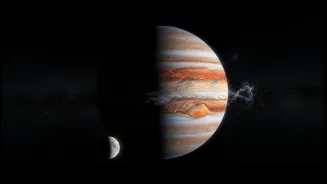
Imagine a world constantly at war with gravity. That’s the reality for Io, the innermost of Jupiter’s four largest moons. Its proximity to the gas giant, combined with the rhythmic gravitational tugs from its neighbouring moons Europa and Ganymede, puts
it in a constant state of flux. This relentless gravitational kneading, known as tidal heating, causes Io’s interior to stretch and flex, generating immense frictional heat. The result is a geologically hyperactive world, one that produces about 100 times more lava each year than all of Earth's volcanoes combined. Plumes of sulfurous gas erupt hundreds of kilometres into space, and vast lava flows continually resurface the moon, erasing any impact craters that form.
The Search for a 'Magma Ocean'
For decades, scientists worked under a relatively straightforward theory to explain this extreme volcanism: a global, subsurface magma ocean. The thinking was that the intense tidal heating had melted a significant portion of Io's mantle, creating a vast, continuous layer of molten rock just beneath the crust. This elegant model seemed to explain why volcanoes were found scattered all over the moon's surface; they were simply vents tapping into this ubiquitous hellish reservoir. Data from NASA's Galileo spacecraft in the 1990s and 2000s provided measurements that were consistent with the presence of a conductive layer, bolstering the magma ocean hypothesis.
Cracks in the Theory
However, as more data became available, this simple picture began to crumble. A detailed analysis revealed a puzzling discrepancy: the volcanoes were not exactly where the tidal heating models predicted they should be. A 2013 study found a systematic offset, with volcanic activity concentrated 30 to 60 degrees east of where the heating was thought to be most intense. More recently, close flybys by NASA's Juno spacecraft delivered an even bigger surprise. By precisely measuring Io's gravitational field, scientists determined that its mantle is mostly solid. The vast, sloshing magma ocean likely doesn't exist. Instead, the new evidence points to a more porous, 'slushy' interior, where pockets of magma exist within a largely solid but deformable rock matrix, similar to the volcanic systems under Iceland or Hawaii.
A New Map Reveals a Deeper Truth
The mystery of Io’s volcanoes has now entered a new chapter, thanks to Juno's advanced instruments. For the first time, scientists have created a global map not just of where the volcanoes are, but of how much heat they are actually emitting. And the results are illuminating. While the physical volcanoes are distributed fairly evenly across the globe, the heat flowing from them is not. Volcanoes in the polar regions, for example, emit far less energy than those at lower latitudes. In another groundbreaking development, Juno’s Microwave Radiometer has managed to peer below the surface, directly measuring the heat rising from the shallow subsurface instead of just reading the temperature of the very top layer.
Reading the Subsurface Heat Signature
This new ability to map subsurface heat patterns is transforming our understanding of Io. The uneven distribution of heat strongly suggests that volcanic activity is not simply a matter of punching a hole through the crust to a waiting magma ocean. Instead, it reflects a far more complex engine at work deep below. The patterns are consistent with models where tidal heat is generated unevenly within the mantle and asthenosphere (the upper, ductile layer of the mantle). Magma may then travel significant distances or pool in localized reservoirs before it ever reaches the surface. The surface volcanoes, therefore, are not just random vents; they are the final expression of a complex, hidden network of heat and magma flow, a map of the moon's dynamic and fiery plumbing.