



A Glimpse of Solar Chaos
The image, featured as NASA's Astronomy Picture of the Day on August 6, 2026, shows a turbulent, mesmerizing landscape that looks more like boiling honey than a distant star. What you're seeing is the Sun's photosphere—its visible surface—at a staggering
resolution. The cell-like structures, known as granules, are each about the size of a small country, bubbling up as hot plasma rises from the Sun's interior, cools, and sinks back down. But the real headline-maker is what’s happening at their edges. For the first time, scientists have clearly seen wave-like swirls and streaks, confirming the existence of a phenomenon called the Kelvin-Helmholtz instability. While the entire patch of the Sun shown is about the size of our planet, the finest details resolved are as small as a city, providing a groundbreaking look at the star's fiery mechanics.
The Eye on the Sun
This unprecedented view comes courtesy of the National Science Foundation's Daniel K. Inouye Solar Telescope (DKIST) in Hawaii, the most powerful ground-based solar observatory in the world. While the telescope is an NSF facility, NASA is a key partner in its scientific mission, helping to analyze and distribute the incredible data it gathers. The image was captured in deep blue visible light and then false-colored yellow to create the familiar solar look. The achievement is a testament to the telescope's advanced optics, which can cut through the distortion of Earth's own atmosphere to produce images of a quality that was once the exclusive domain of space-based observatories. This allows scientists to study the Sun's surface with a clarity that bridges the gap between different observation methods.
Why This Instability Matters
So what is the Kelvin-Helmholtz instability (KHI)? It’s a common phenomenon that occurs when two fluids moving at different speeds slide past each other, creating a shear that grows into vortices—think of wind blowing over water to create waves. On the Sun, this happens where streams of magnetic plasma flow past each other at different velocities. While KHI has been observed in Earth's clouds and on other planets like Jupiter, seeing it on the Sun's surface is a game-changer. Scientists have long hypothesized it occurs there, but never had the visual proof. Researchers believe this instability could be a crucial, missing piece in the puzzle of solar physics. It may play a key role in transferring energy from the Sun's surface to its outer atmosphere, the corona, potentially explaining why the corona is hundreds of times hotter than the surface below—one of the longest-standing mysteries in astrophysics.
Seeing the Sun in a New Light
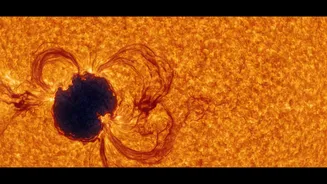
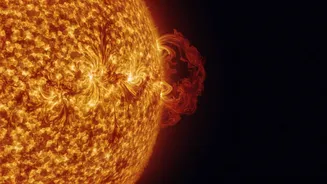
Many of the most famous and dramatic images of the Sun, often released by NASA's Solar Dynamics Observatory (SDO), are taken in ultraviolet (UV) or X-ray wavelengths. Our eyes can't see this light, but space telescopes can, and they reveal the Sun's super-heated upper atmosphere, the corona, where dramatic events like solar flares and coronal mass ejections erupt. Those images are vital, but they don't show the surface in the same way. Visible-light imaging, like that from DKIST, provides an unparalleled look at the photosphere itself—the source of all that energy. It’s the difference between seeing the glow of a fire and being able to watch the wood itself burn. By capturing the fundamental processes happening on the Sun's 'skin' in such high detail, scientists can better understand the engine that drives solar weather, which can have significant effects on Earth's technology, from satellites to power grids.