


A New Watchman for the Sun
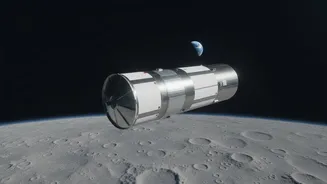
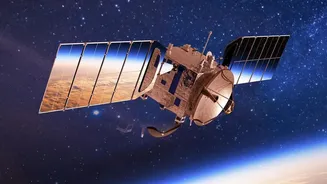
Meet PUNCH, which stands for Polarimeter to Unify the Corona and Heliosphere. It’s not one satellite, but a constellation of four suitcase-sized spacecraft launched in March 2025. Working together, they act as a single virtual instrument to do something
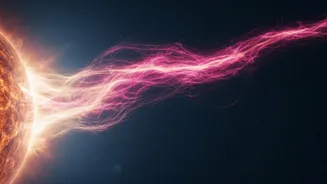
remarkable: create a continuous, 3D movie of the solar wind, the stream of charged particles constantly flowing from the sun. Their primary job is to track major solar eruptions, known as coronal mass ejections (CMEs), as they travel from the sun towards Earth.
Closing a Critical Blind Spot
Until now, forecasting space weather has had a major blind spot. Scientists could see a CME explode from the sun's outer atmosphere, the corona, and instruments near our planet could measure its impact upon arrival. But the vast journey in between—covering millions of kilometers—was largely a matter of guesswork. It was like seeing a cyclone form off the coast but then losing track of it until it makes landfall. This uncertainty meant that forecasts for a CME's arrival could have an error window of five hours or more. PUNCH was designed specifically to solve this problem by imaging the solar wind across this previously unobserved gap.
Making the Invisible Visible
So how does PUNCH see something as tenuous as the solar wind? It doesn't look directly at the sun. Instead, its specialized cameras detect the faint visible light that scatters off the free electrons within the solar wind plasma. By combining images from its four spacecraft, which take a new picture every four minutes, the mission can piece together a panoramic view, tracking the front of a CME as it expands and moves through the solar system. This continuous stream of images allows scientists to follow the storm’s complete path, providing an unprecedented view of its speed, trajectory, and evolution.
From Test Run to Triumph
In a groundbreaking proof-of-concept test, scientists used PUNCH's data from a CME that occurred on May 31, 2025, to retroactively forecast its arrival. By feeding the continuous imagery into a computer model, they tracked the storm's leading edge. Twelve hours after the eruption, the model locked in a final prediction for when it would reach Earth. The result was stunning: the forecast was accurate to within 30 minutes. This represents a tenfold improvement in accuracy over previous methods, a leap that one lead scientist compared to moving from a steam engine to a modern combustion engine.
The Real-World Stakes
This newfound precision is more than just an academic achievement. Intense solar storms can have severe consequences on Earth. They can induce powerful currents in electrical grids, potentially causing widespread blackouts and damaging transformers. They disrupt high-frequency radio communications and can degrade GPS signals, affecting everything from aviation to logistics. Satellites, which form the backbone of our global communications and data networks, are especially vulnerable to damage from solar radiation. A highly accurate, reliable forecast gives power grid operators, satellite controllers, and airlines crucial hours of lead time to take protective measures, saving billions in potential damages and preventing catastrophic failures.