


1. The Crimson Citadel: Red Fort, Delhi
Our journey begins at the heart of Mughal power, the Red Fort, or Lal Qila. Commissioned by Emperor Shah Jahan in 1639 when he moved the capital from Agra, its massive red sandstone walls enclose a treasure of palaces, halls, and gardens. For nearly 200
years, it was the main residence of the Mughal emperors. Today, it stands as a powerful symbol of India's sovereignty, where the national flag is hoisted every Independence Day, connecting a dynastic past with a democratic present.
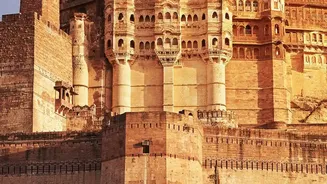
2. The Fort of the Sun: Mehrangarh Fort, Jodhpur
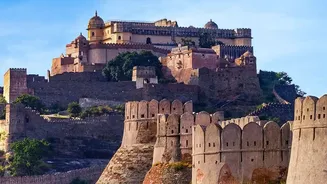
Perched on a 122-meter-high hill, Mehrangarh Fort seems to rise organically from the rock itself. Founded by Rao Jodha in 1459, this fort has walls so high and thick—up to 36 meters—that it appears almost impregnable. Inside, a series of palaces with intricately carved latticework and sprawling courtyards tell the story of the Rathore clan's power and aesthetic refinement. The view from the top offers a breathtaking panorama of Jodhpur's famous blue houses, creating a striking visual contrast.
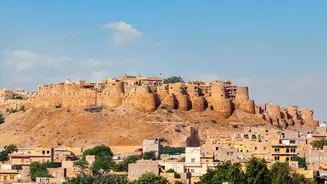
3. The Golden Fortress: Jaisalmer Fort, Jaisalmer
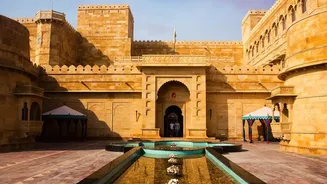
Unlike many other forts that are purely monuments, Jaisalmer Fort is a living heritage site. Built in 1156 by Rawal Jaisal, it is one of the oldest and largest desert forts in the world. Its yellow sandstone walls blend into the surrounding Thar Desert, glowing like gold at sunset, which earned it the name Sonar Quila or the Golden Fort. Remarkably, a significant portion of the old city's population still resides within its ancient walls, making it a bustling hub of homes, temples, and shops.
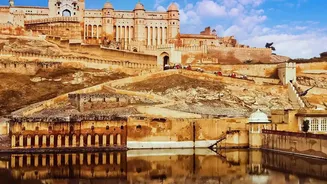
4. The Predecessor to the Taj: Agra Fort, Agra
Often overshadowed by its famous neighbour, the Taj Mahal, Agra Fort is a historical masterpiece in its own right. A UNESCO World Heritage site, this fortress of red sandstone was the main residence of the Mughal emperors until they shifted their capital to Delhi. While Emperor Akbar began its reconstruction in 1565, it was his grandson, Shah Jahan—who also built the Taj—that embellished it with white marble palaces. It was here that Shah Jahan was imprisoned by his son Aurangzeb, spending his last years gazing at the distant tomb of his beloved wife.
5. The Symbol of Sacrifice: Chittorgarh Fort, Rajasthan
Sprawling across a 700-acre hilltop, Chittorgarh is the largest fort in India and a symbol of Rajput pride and valor. For centuries, it was the capital of the Mewar kingdom and witnessed several ferocious sieges. The fort is tragically famous for the practice of jauhar, where Rajput women chose mass self-immolation over capture by invading armies. Its grounds are home to palaces, temples, and the iconic Vijay Stambh (Tower of Victory), each structure echoing tales of heroism and sacrifice.
6. The Diamond Capital: Golconda Fort, Hyderabad
Once the capital of the Qutb Shahi dynasty, Golconda Fort was renowned as a major center for the diamond trade. The fort, which originated as a mud structure in the 11th century, is famous for its ingenious acoustics; a clap at the entrance gate can be heard at the highest point of the citadel, a feature designed as a warning system. Even in ruins, its palaces, mosques, and imposing gateways speak of a time when its name was synonymous with immense wealth.
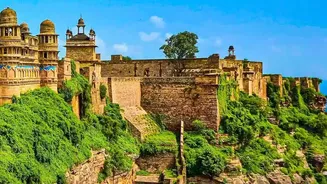
7. The Gibraltar of India: Gwalior Fort, Madhya Pradesh
With a history stretching back to at least the 6th century, Gwalior Fort is one of India's oldest and most formidable citadels. Described by the Mughal emperor Babur as "the pearl amongst the fortresses of Hind," its strategic location and massive walls earned it the nickname "Gibraltar of India." The fort complex is vast, housing several palaces, including the Man Mandir Palace with its stunning blue-tiled facade, and numerous temples, one of which contains the second oldest known record of the number 'zero'.