



Meet Our New Cosmic Cartographer
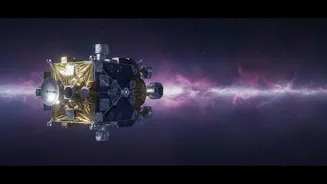
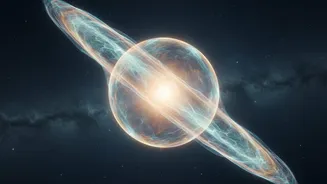
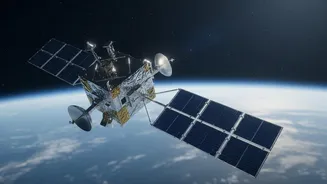
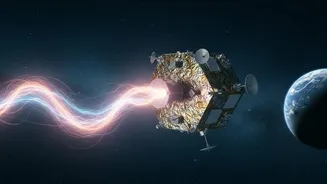
Launched in September 2025, NASA's Interstellar Mapping and Acceleration Probe, or IMAP, is on a crucial mission. Its job is to study the boundary of the heliosphere, which is the vast magnetic bubble inflated by the Sun’s own solar wind. This bubble acts
as a shield, protecting our solar system from a significant amount of intense radiation coming from the wider galaxy. Positioned about 1.5 million kilometres from Earth towards the Sun, IMAP is perfectly placed to intercept and analyze particles from the Sun, the far reaches of our solar system, and the interstellar space beyond. It’s equipped with ten sophisticated instruments designed to provide the most comprehensive picture yet of this dynamic and vital region.
The Solar System's Edge Explained
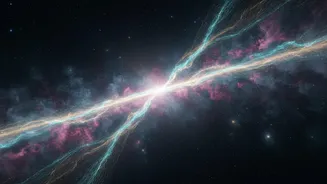
When we talk about the 'edge' of the solar system, we're not talking about the orbit of the farthest planet. We're referring to the heliopause — the boundary where the Sun's influence, carried by the solar wind, finally dwindles and gives way to the interstellar medium. The solar wind is a constant stream of charged particles flowing from the Sun at incredible speeds. As it travels outward, it pushes against the gas and dust between the stars, forming the protective heliosphere. Understanding this boundary is not just an academic exercise; the heliosphere's strength and shape dictate how many galactic cosmic rays can enter our solar system. These rays can pose a danger to astronauts and interfere with our technology, both in orbit and on the ground.
First Glimpses from the Frontier
In early August 2026, NASA made the first public release of science data from seven of IMAP's ten instruments. This initial dataset offers a treasure trove of information about the particles and magnetic fields that make up our corner of space. Instruments like the Solar Wind and Pickup Ions (SWAPI) sensor are measuring ions from both our Sun and those that have drifted in from interstellar space. Meanwhile, the Compact Dual Ion Composition Experiment (CoDICE) is measuring the mass and charge of these particles, helping scientists distinguish between local material and galactic visitors. The data also includes measurements of the interplanetary magnetic field, solar wind electrons, and even interstellar dust, providing a multi-faceted view of the forces shaping our cosmic neighborhood.
A Cosmic Weather Forecast
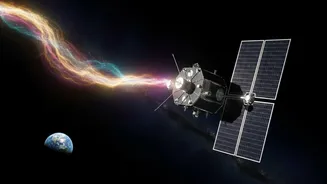
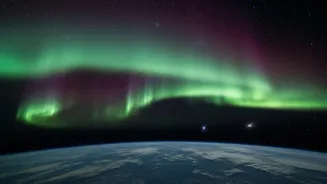
Beyond mapping the distant frontier, IMAP has a very practical, real-time job. A portion of its data is streamed back to Earth continuously to enhance space weather forecasting. This system, known as I-ALiRT (IMAP Active Link for Real-Time), can provide about a half-hour's warning of incoming solar energetic particles, which can be harmful to astronauts and satellites. Forecasters at NOAA’s Space Weather Prediction Center are using this new stream of information, which includes data on high-energy electrons and solar wind composition, to improve the timeliness and accuracy of their alerts and warnings. This is especially critical as humanity plans more ambitious missions, such as those under the Artemis program, which will take astronauts far beyond the protection of Earth's magnetic field.
Just the Beginning of the Journey
This first data release is just the beginning for IMAP. Led by Princeton University and involving over 25 partner institutions, the mission represents a major international collaborative effort. As the spacecraft continues to collect information, scientists will build a three-dimensional map of the heliosphere, watching how it breathes—stretching and shrinking in response to the Sun's 11-year activity cycle. By understanding the intricate dance between the solar wind and the interstellar medium, we learn more about the conditions that allowed life to flourish on Earth. This knowledge not only illuminates our own solar system's past and future but also provides crucial clues in the search for habitable environments around other stars.