






A Planet’s Invisible Shield
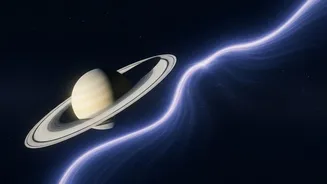
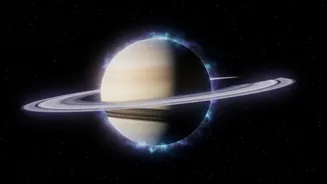
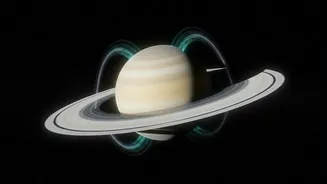
Every magnetised planet, including our own, is surrounded by an invisible shield called a magnetosphere. This bubble is created by the planet's internal magnetic field and deflects most of the harmful, highly charged particles streaming from the Sun,
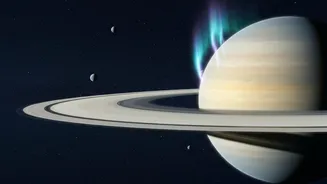
known as the solar wind. On Earth, this shield is relatively symmetrical. The solar wind compresses the side facing the Sun and stretches the side facing away into a long tail. A key feature is the 'cusp' – a funnel-like opening near the poles where some solar particles can leak in, creating the spectacular aurorae. On Earth, this cusp is typically located around the planet's 'local noon' position, directly facing the Sun. For years, scientists assumed other planets would behave similarly. However, new research shows Saturn breaks the rules.
Saturn’s Lopsided Anomaly
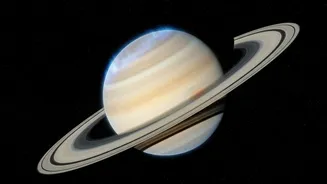
A recent analysis of six years of Cassini data has revealed that Saturn's magnetosphere is fundamentally lopsided. Instead of being located at the 12 o'clock position (local noon), Saturn's magnetic cusp is consistently dragged far into the afternoon, often appearing between 1 and 3 o'clock. This consistent asymmetry was a surprise, suggesting that the forces shaping Saturn's magnetic environment are very different from those at play on Earth. The new findings confirm a long-held theory that for giant, fast-spinning planets, internal dynamics can overpower the influence of the solar wind. Two key factors are responsible for this planetary-scale distortion.
The Double Act: Fast Spin and Moon Debris
The first culprit behind the distortion is Saturn’s incredible rotation speed. A day on the gas giant lasts only 10.7 hours. This rapid spin effectively drags the magnetic field along with it. The second, and equally important, factor is the constant supply of material from its moons, particularly the icy moon Enceladus. Geysers on Enceladus continuously spew water vapour and ice particles into space, feeding a massive plume. This material becomes ionised—electrically charged—and gets caught in Saturn's magnetic field, forming a heavy, dense soup of plasma that the planet has to drag around. The combination of this rapid spin and the heavy plasma load is what researchers believe pulls the magnetic field and its cusp toward the dusk, or afternoon, side of the planet.
Why This Discovery Matters
Understanding this distortion does more than just solve a planetary puzzle. It provides a new framework for how magnetospheres work on fast-rotating gas giants. This is crucial not just for studying Jupiter, but also for interpreting observations of exoplanets orbiting other stars. Many models used to understand these distant worlds are based on Earth's magnetosphere, but this discovery shows that a 'one size fits all' approach doesn't work. Furthermore, knowing the precise location of Saturn's cusp helps scientists better understand where and how energy enters its atmosphere, which directly relates to the formation of its powerful aurorae. It also gives vital context for future missions, including a planned return to Saturn and its potentially life-harbouring moon, Enceladus, in the 2040s.