

Anatomy of a Cosmic Explosion
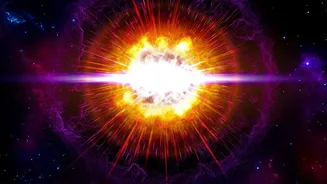
Imagine a star many times more massive than our Sun reaching the end of its life. Having exhausted its nuclear fuel, the delicate balance between gravity pulling inwards and fusion pushing outwards is broken. Gravity wins, catastrophically. The star’s
core collapses in on itself in less than a second, creating unimaginably dense matter and launching a powerful shockwave outwards. But here’s the problem that has puzzled astrophysicists for decades: this initial shockwave almost always stalls. It doesn’t have enough energy on its own to blast through the star's outer layers. Instead, it gets stuck, and the star should, by all rights, just collapse. Yet we see supernovae all the time. Something must be reigniting the explosion.
Enter the 'Ghost Particle'
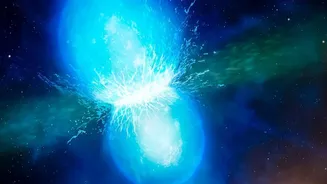
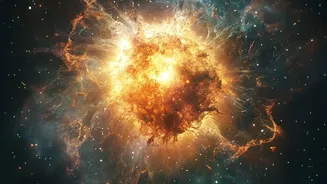
That ‘something’ is the neutrino. These elementary particles are famously elusive; they have almost no mass, no electric charge, and barely interact with other matter. Trillions pass through your body every second without a trace. But during a star’s core collapse, the conditions are so extreme that an astonishing 99% of the explosion's colossal energy is carried away by a flood of neutrinos. The leading theory, known as the neutrino-driven mechanism, posits that even though a single neutrino does almost nothing, this immense swarm can act collectively. By slamming into the material behind the stalled shockwave, they deposit just enough energy to re-energize it, turning a failed fizzle into a glorious supernova.
A New Twist in the Tale
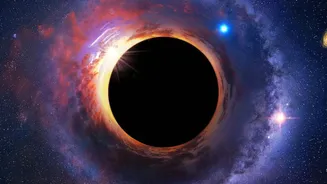
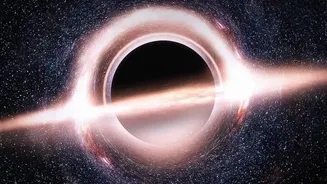
Recent simulations have added a fascinating layer of complexity, putting neutrinos even more squarely at the centre of the outcome. A study from the University of Copenhagen highlighted a subtle property of neutrinos called 'flavor conversion'. Neutrinos come in different types, or flavors, and can switch between them. For a long time, this was thought to be a minor detail. However, the new models, which incorporated this flavor-changing behaviour, produced a shocking result. For a significant range of stars, particularly those between 16 and 30 times the mass of our sun, including neutrino flavor conversion flipped the predicted outcome. Instead of exploding, these stars suddenly failed, collapsing directly into black holes. This suggests the specific behaviour of neutrinos isn't just a helper in the explosion; it can be the ultimate decider of the star's fate.
The Problem with a Flat Reality
This brings us to the second part of the puzzle: the simulations themselves. While the new research on neutrino flavors is a breakthrough, it, like many previous models, was not run in full three-dimensional reality. For decades, the immense computing power needed to simulate a supernova forced scientists to use simplified one-dimensional (1D) or two-dimensional (2D) models. A 1D model treats the star as a perfect sphere, collapsing uniformly. But in reality, stars are messy. They churn with activity. Using a 1D model to understand a supernova is like trying to understand a hurricane by looking at a single point on a map. You miss the entire structure.
Why Three Dimensions Are Crucial
Moving from 1D to 3D increases the computational complexity by a factor of 10,000, demanding immense supercomputing power. However, these 3D simulations are proving essential because they can model the chaos that 1D and 2D models miss. In 3D, scientists can see the development of turbulence and large-scale, asymmetric sloshing motions inside the star. These violent, chaotic movements are not just noise; they are a critical part of the explosion mechanism. They help transport the neutrino energy more efficiently to the stalled shockwave, increasing the chances of a successful explosion. The fact that including neutrino flavor physics is still too computationally demanding for most full 3D simulations shows just how challenging this frontier is.
Unlocking Our Cosmic Origins
Getting these simulations right is about more than just satisfying scientific curiosity. Supernova explosions are the universe's great foundries. They are responsible for creating and scattering most of the heavy elements across the cosmos—the oxygen we breathe, the calcium in our bones, and the iron in our blood were all forged in the heart of a dying star and flung into space by its explosive death. By accurately modeling how these explosions work, we can better understand how the raw materials for planets, and ultimately life, came to be. Understanding the fate of a distant star is, in a very real way, understanding a piece of our own origin story.