

The Most Volcanic World We Know
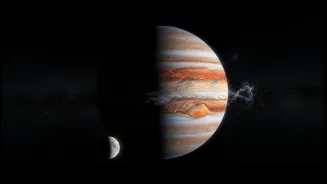
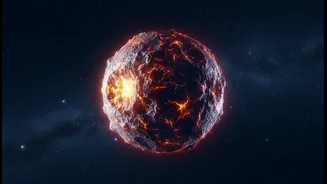
Jupiter’s moon Io is, without exaggeration, the most volcanically active body in our solar system. Caught in a relentless gravitational tug-of-war between the colossal gas giant and its neighboring moons Europa and Ganymede, Io is constantly stretched
and squeezed. This process, known as tidal heating, generates tremendous friction and heat within the moon's interior, making it a planetary-scale pressure cooker. The result is a chaotic and constantly changing landscape. Ever since the Voyager mission first spotted a live eruption in 1979, we’ve been captivated by this world of fire and brimstone, where hundreds of volcanoes spew sulfurous compounds across a canvas of yellow, red, and black. Its surface is so active that it is completely remade on a geological timescale of about a million years.
Seeing Is Only Half the Story
Our view of Io has largely been shaped by cameras that capture visible light, much like our own eyes. These spacecraft images have provided breathtaking portraits of giant lava flows and umbrella-shaped plumes soaring hundreds of kilometers into space. But they have a fundamental limitation: they primarily show the surface. While infrared instruments can sense the temperature of the very top layer, they can't tell us what's happening just a few feet below, where the real thermal action is. Scientists knew that the spectacular eruptions were only part of the equation, but they couldn't get a clear picture of how Io's immense internal heat was actually escaping on a global scale. The visual story was dramatic, but it was incomplete.
A New Way to Take Io’s Temperature
Enter NASA's Juno spacecraft and its Microwave Radiometer (MWR) instrument. During two recent close flybys of Io, this instrument did something revolutionary: it peered beneath the moon’s rocky, frozen crust. Unlike a camera that sees light, the MWR measures microwave radiation, a form of light that can pass through solid materials. By tuning to its lowest frequencies, scientists could effectively take the temperature of Io's subsurface, penetrating up to 20 feet deep. This provided the first-ever direct measurements of heat rising from below. The data collected during these daring passes, which brought Juno within about 930 miles of Io, was used to create a groundbreaking heat map, revealing a hidden dimension of this fiery world.
What the Hidden Heat Reveals
The new map is full of surprises. It shows that the temperature just a few feet below the surface is often significantly warmer than the top layer, a clear sign of heat rising from the interior. More startlingly, the heat isn't just concentrated at the visually obvious volcanoes. The map reveals massive regions of subsurface warmth, including one anomaly where the temperature is up to 36 degrees Fahrenheit warmer than its surroundings. This suggests that significant internal heating is happening across large areas within the upper crust. The distribution of this heat is also puzzling; more energy seems to be escaping from mid-latitudes than from the poles, and the northern polar volcanoes emit twice as much energy as those in the south. These findings challenge previous models that suggested a uniform global magma ocean might be hiding just beneath the crust.
Rewriting the Book on Volcanic Worlds
This new understanding of Io has profound implications. By showing how and where tidal heat escapes, it provides crucial data for refining models of this fundamental planetary process. The same forces that power Io's volcanoes are believed to maintain the subsurface liquid water oceans on other moons like Europa and Enceladus, which are prime targets in the search for extraterrestrial life. Understanding Io helps us understand how these potentially habitable worlds work. The discovery that we can peer below the surface of a rocky moon using microwave instruments also opens up new possibilities for studying Earth's own volcanoes and other geologically active bodies in our solar system and beyond. The new heat map proves that to truly know a world, you have to see the invisible forces that shape it.