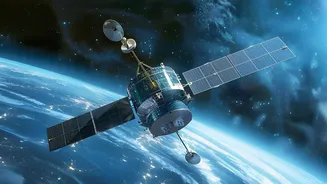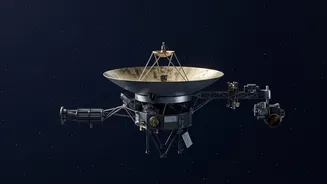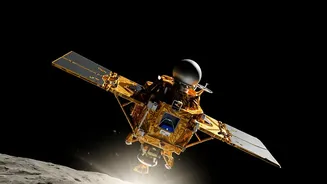








After nearly 22 years of unlocking cosmic secrets, NASA's Neil Gehrels Swift Observatory took its final bow. On November 4, 2026, the venerable spacecraft made a planned, fiery descent into Earth's atmosphere, ending a remarkably successful mission.
A Legacy of Cosmic Discovery
Launched
on November 20, 2004, the Swift Observatory was originally designed for a two-year mission. Its primary goal was to solve the mystery of gamma-ray bursts (GRBs), the most powerful explosions in the universe since the Big Bang. The satellite was a marvel of engineering, equipped with three telescopes that allowed it to detect a GRB, autonomously swivel to face it, and study its fading afterglow across X-ray, ultraviolet, and optical light—often in under a minute. This rapid-response capability was revolutionary, giving scientists an unprecedented look at these fleeting, violent events. Over two decades, Swift far exceeded its original mandate, observing over 2,000 GRBs and contributing to some 7,000 scientific papers. It also studied supernovas, comets, asteroids, and stars being torn apart by black holes, becoming a versatile tool for astronomers worldwide.
An Unavoidable Fall From Orbit
Like all objects in low-Earth orbit, Swift was in a constant battle with gravity and atmospheric drag. Though space at its altitude of roughly 600 kilometers seems empty, there are still wisps of atmosphere that gradually slow a satellite down. Without an onboard propulsion system to boost its orbit, Swift's path was always destined to decay. This process was accelerated in recent years by increased solar activity, which caused Earth's upper atmosphere to expand, creating more drag. NASA's mission ended on October 23, 2026, when the spacecraft's orbit had dropped to about 275 kilometers, an altitude where the drag became too great for the telescopes to maintain a steady aim at cosmic targets. A daring commercial rescue mission intended to boost Swift into a higher orbit was attempted but ultimately failed, sealing the observatory's fate.
The Science of a Fiery Re-entry
The reason most of the 1,450-kilogram observatory was expected to disintegrate is due to the incredible physics of re-entry. As Swift plunged into the denser layers of the atmosphere, it was traveling at hypersonic speeds of over 28,000 kilometers per hour. At this velocity, the air in front of the spacecraft can't move out of the way fast enough. Instead, it gets compressed into a superheated shockwave of plasma, reaching temperatures hot enough to melt most metals. This intense heat, generated primarily by compression rather than simple friction, causes the satellite's structure—largely made of materials like aluminum—to vaporize. This process of burning up is standard for deorbiting satellites and is a key part of strategies to mitigate the growing problem of space debris.
What Survived the Plunge?
While the majority of Swift was vaporized, it's common for some denser, more heat_resistant components to survive the journey to the surface. NASA and the U.S. Space Force closely tracked the re_entry, which occurred at 7:39 a.m. EST on November 4 over the North Sumatra region of Indonesia. Before the event, NASA calculated the risk of harm to anyone on the ground at approximately 1 in 2,100, a figure considered unlikely. This type of uncontrolled re_entry was planned for, with the knowledge that any surviving fragments were most likely to fall into the ocean or remote, unpopulated areas. As of the event, no reports of damage or injuries were made. The end_of_life plan for Swift was in line with practices for many satellites of its era, although guidelines for modern satellites are becoming even stricter, often requiring a deorbit within five years of mission completion.