








The Modern Connection to an Ancient Fort
The name Nana Patekar is synonymous with powerful cinematic performances, but his story begins in Murud-Janjira, the very town that lies in the shadow of the legendary sea fort. Born Vishwanath Patekar in this coastal Maharashtrian town, the actor’s roots
are tied to the region. In interviews, Patekar has mentioned that his mother moved the family to Murud to provide a safe distance from certain troubling influences in Mumbai. This personal history forms a compelling modern link to a landmark defined by its legacy of providing sanctuary and standing unconquered for centuries. It is this enduring mystique of the fort that continues to captivate visitors and locals alike, connecting generations to its storied past.
A Fortress Born from the Sea
The story of Murud-Janjira begins not as a stone behemoth, but as a humble wooden structure built by local Koli fishermen in the 15th century to defend against pirates. Its strategic potential was soon recognised. The fort was captured and then transformed by the Siddis, a community of African origin who established themselves as formidable naval commanders in the service of the Ahmadnagar Sultanate. The name 'Janjira' itself is derived from the Arabic word 'Jazira', meaning island. Under the Siddis, the wooden structure was replaced by an imposing stone fortress, turning the rocky outcrop into a virtually impregnable bastion that would dominate the Konkan coast for centuries.
Brilliance in Design and Defence
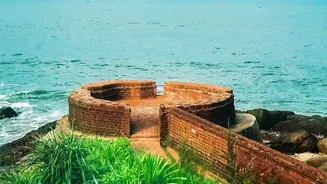
The fort’s reputation as 'unconquered' is a testament to its brilliant and intimidating design. Its 40-foot-high walls rise directly from the sea, making any amphibious assault incredibly difficult. The main entrance is a masterpiece of deception, completely hidden from view until an approaching boat is almost upon it, a mere 40 feet away. This denied enemy ships a clear target for their cannons. The fort was armed with formidable artillery, including three massive cannons named Kalaal Baangadi, Chavri, and Landa Kasam, which were feared for their range. Furthermore, the fortress was remarkably self-sufficient, containing its own freshwater lakes, a palace, a mosque, and living quarters, allowing its defenders to withstand long sieges.
Centuries of Failed Conquests
Many have tried and all have failed to capture Janjira by force. The list of challengers includes the most powerful empires of their time: the Portuguese, the British, the Dutch, and most notably, the Marathas. Chhatrapati Shivaji Maharaj, known for his military genius and success in capturing forts, made several attempts on Janjira but could not breach its defences. One of the largest assaults in 1676, led by Peshwa Moropant Pingle, was repulsed. His son, Chhatrapati Sambhaji Maharaj, came incredibly close. In 1682, he launched a massive siege, even starting to build a causeway of stone to connect the island to the mainland. However, a timely Mughal invasion of his own capital forced him to withdraw his forces, leaving Janjira’s defenses intact.
The Siddis: Masters of the Konkan Coast
The successful defence of Janjira is inseparable from the story of the Siddis. Originally from Abyssinia (modern-day Ethiopia), they rose from military slaves to become powerful, autonomous rulers of their sea-bound kingdom. Their naval prowess was legendary, allowing them to not only defend their fort but also control maritime trade routes and project power along the coast. They allied with larger powers like the Mughals to secure their position but remained fiercely independent in their stronghold. For over two centuries, from the 1600s until 1947, the fort remained under the unbroken rule of the Siddi dynasty. It was never conquered in battle; its integration into modern India came through political agreement after independence.