






The Fading Heartbeat of an Explorer
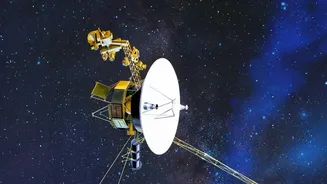
Launched in 1977, the Voyager 1 and 2 spacecraft are humanity’s most distant emissaries, having traveled billions of kilometers into interstellar space. Their journey was never meant to last this long. Powered by radioisotope thermoelectric generators
(RTGs), which convert heat from decaying plutonium into electricity, they were designed for a five-year mission to the outer planets. Now, almost 50 years later, that nuclear heartbeat is fading. The plutonium's natural decay means that each spacecraft loses about four watts of available power every year. For machines operating on razor-thin margins in the coldest reaches of space, those four watts represent the difference between discovery and darkness.
An Energy Budget in Deep Space
The power available to the Voyager probes is now a fraction of what it was at launch. The total output is so low that it would struggle to power a modern laptop, let alone a complex spacecraft communicating across a distance that light takes nearly a full day to cross. This dwindling supply has forced mission managers at NASA's Jet Propulsion Laboratory into a long, careful process of energy triage. For years, they have been systematically shutting down non-essential systems, starting with heaters for instruments used only for planetary flybys decades ago. Now, the choices are becoming more difficult, forcing engineers to decide which of the few remaining science instruments must be powered down to keep the mission alive.
The 'Big Bang' Power Hack
Faced with shutting off another science instrument on Voyager 2, the engineering team devised a risky but ingenious plan nicknamed the 'Big Bang'. The maneuver involved simultaneously shutting down a group of powered devices and replacing them with lower-power alternatives to keep the spacecraft warm enough to function. In the extreme cold of interstellar space, allowing fuel lines to freeze would mean losing the ability to aim the probe's antenna at Earth, effectively ending the mission. The gamble paid off. The power-saving swap was successful, freeing up enough energy to keep Voyager 2's three remaining active science instruments operating for at least another year. This success has provided a blueprint for a similar operation planned for the even more distant Voyager 1.
The Science of Frugality
Every watt saved is a victory for science. Though they have been forced to power down instruments over the years, the Voyagers are still collecting invaluable data. As the only spacecraft to ever operate in interstellar space—the region between the stars—they are our only direct source of information about the environment beyond the Sun's protective bubble, the heliosphere. The remaining instruments are studying the fields and particles that dominate this unexplored territory. Scientists believe the data returned by the probes becomes more valuable the farther they travel from home, providing a unique perspective on our place in the galaxy. This is why engineers are fighting so hard for every extra day, month, and year of operation.
A Long and Silent Goodbye
Even with the team's ingenuity, the end is inevitable. Engineers hope to keep receiving science data until at least 2027, the mission's 50th anniversary, with a stretch goal of staying in contact into the 2030s. Eventually, however, there will not be enough power to run even a single instrument or transmit a signal back to Earth. When that day comes, the Voyagers will fall silent. They will not stop, however. They will continue their journey through the Milky Way, carrying with them the Golden Records—a message from humanity to any civilization that might one day encounter them. They will become silent, drifting monuments to human curiosity and the incredible engineering that sent them on their way.