




The Galaxy's Most Common Planet
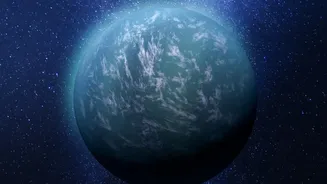
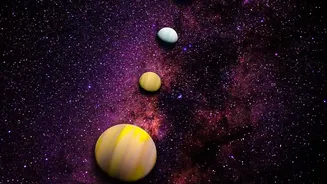
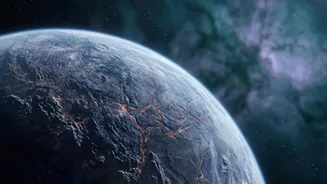
When we scan the skies for exoplanets, we find super-Earths everywhere. These are worlds with a mass greater than Earth’s but significantly less than that of ice giants like Neptune. They are the most common type of planet discovered in our galaxy, with some
studies suggesting they orbit at least 30% of Sun-like stars. These can be rocky worlds or small gas planets, and they often orbit their stars much closer than Mercury orbits our Sun. This makes their absence in our own solar system a profound mystery. For decades, scientists have wondered: were they destroyed, or did they simply never have a chance to form? The answer tells a dramatic story about our own origins.
The Wrecking Ball Hypothesis
An early and influential theory for our super-Earth deficit is the “Grand Tack” hypothesis. This model suggests that in the early days of the solar system, a young Jupiter didn’t stay put. Instead, it migrated inward, perhaps as close as Mars’s current orbit, before being pulled back out by the gravitational influence of a newly formed Saturn. Like a giant ship tacking against the wind, Jupiter’s journey would have been catastrophic for anything in its path. According to this model, Jupiter’s inward migration could have acted like a cosmic wrecking ball, pushing a cascade of rocky debris and even a first generation of inner planets into the Sun. This would have effectively wiped the slate clean, preventing any close-in super-Earths from surviving or forming.
A New Recipe: Cosmic Rings and Pressure Bumps
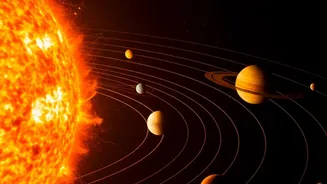
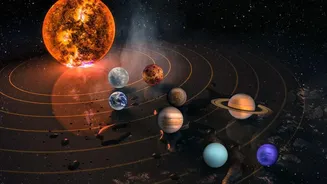
More recent computer simulations offer a less violent but equally profound explanation. Instead of a uniform disc of gas and dust, these new models propose that the young Sun was surrounded by distinct rings of material, separated by gaps created by “pressure bumps”. These bumps acted like dams, causing dust to pile up in specific zones. Observations of distant, young stars have shown similar ringed structures, lending weight to this idea. According to simulations run by a team of astrophysicists, our early solar system likely had three such major rings. The key is that these rings were disconnected, which severely limited the amount of material available in the innermost part of the solar system.
Not Enough Material to Go Super
This ring-based model elegantly explains the super-Earth mystery without needing a planetary demolition derby. The innermost ring simply didn't contain enough raw material to build a planet much larger than Earth or Venus. The pressure bumps prevented a steady flow of pebbles and dust from the outer solar system from drifting inward. Had that material been available, Earth itself might have continued growing into a much larger super-Earth. The middle ring contained the mass to form the gas giants, and the outer ring was the birthplace of comets and other icy bodies. This theory not only explains the missing super-Earths but also accounts for the stark compositional differences between the inner rocky planets and the outer gas giants, solving multiple puzzles at once.
Did the Sun Eat a Planet?
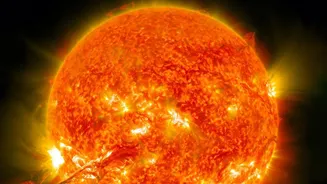
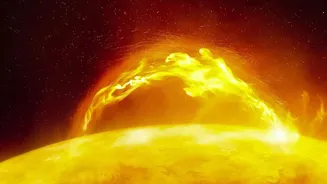
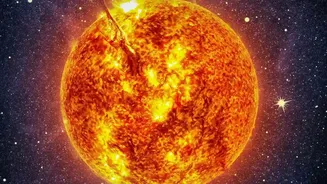
Another intriguing, and very recent, model doesn't contradict the others but adds a dramatic twist. Research published in 2026 suggests the young Sun may have actually swallowed a super-Earth that managed to form in the inner solar system. A team of scientists proposes that a planet five to ten times Earth's mass could have spiraled inward and been consumed by our star billions of years ago. This event would have left subtle chemical fingerprints, potentially explaining some long-standing anomalies in the Sun's composition, like its surprisingly low levels of lithium. While this idea is based on computer modeling, it presents a fascinating possibility that our Sun holds the secret to a lost world.