



Meet the Real Shadow Blaster
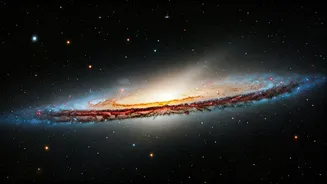
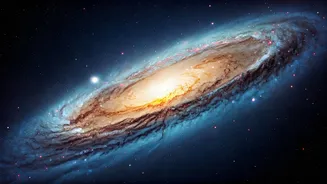
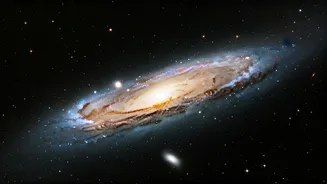
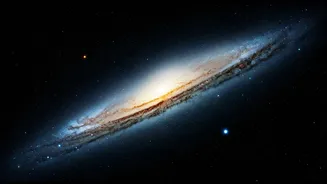
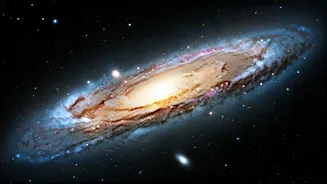
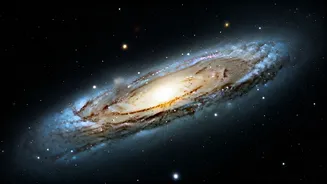
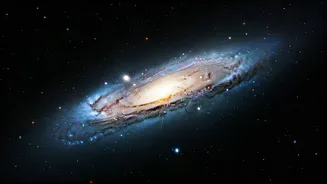
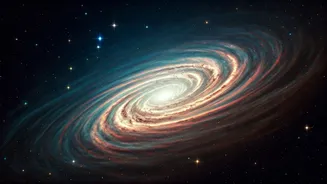
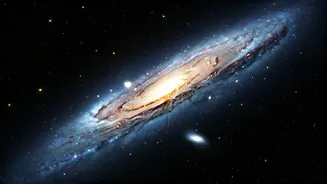
The Shadow Blaster is the nickname for an incredibly distant and ancient galaxy, officially known as JCMT0402−0424. Located roughly 11 billion light-years away, we are seeing it as it was when the universe was just a toddler. The name was coined by astronomers
because this galaxy, while exceptionally bright in infrared light, is almost completely invisible to optical telescopes. It is shrouded in a thick veil of cosmic dust, hiding in the shadows of space while furiously 'blasting' out new stars. This discovery became monumental when scientists traced a single, high-energy particle that hit a detector in Antarctica back to this very galaxy.
Chasing Cosmic Ghosts
The particle in question was a neutrino, an elementary particle so strange it's often called a 'ghost particle'. Neutrinos have almost no mass and no electric charge, meaning they can travel through planets, stars, and even our own bodies without leaving a trace. While trillions pass through you every second, detecting the rare, high-energy ones from deep space is a monumental task. Facilities like the IceCube Neutrino Observatory, which buried a cubic kilometre of sensors deep in the Antarctic ice, were built for exactly this purpose. Finding where these high-energy neutrinos come from is a holy grail of modern astrophysics, as it points us directly to the most powerful particle accelerators in the universe.
A New Type of Cosmic Engine
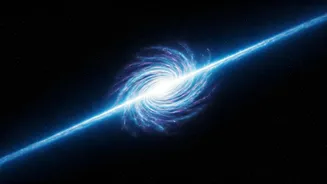
For a long time, the prime suspects for creating these powerful neutrinos were active galaxies with supermassive black holes at their centres, which launch powerful jets of material into space. The Shadow Blaster discovery challenges this assumption. When astronomers studied the galaxy, they found no evidence of an active, feeding black hole. Instead, they found an environment of intensely rapid star formation, known as a starburst. The research suggests that the dense, gas-rich core of a galaxy like Shadow Blaster can, on its own, act as a natural particle accelerator powerful enough to generate high-energy neutrinos. This is a game-changing revelation, offering a new type of source to explain the mysterious particles.
A Little Help from Gravity
Observing a galaxy so faint and far away would normally be impossible. The scientific team behind this discovery got a huge assist from a natural phenomenon known as gravitational lensing. By cosmic chance, another massive galaxy sits directly between Earth and the Shadow Blaster. The immense gravity of this foreground galaxy acts like a natural telescope, bending and magnifying the light from the Shadow Blaster behind it. This 'cosmic magnifying glass' allowed instruments like the ALMA and Gemini North telescopes to peer into the distant galaxy's core and determine its properties—a feat of cosmic teamwork between human technology and the laws of physics.
Rewriting the Neutrino Map
So, how does this one event change everything? Scientists have detected many high-energy neutrinos over the years but have been unable to pinpoint a source for most of them. This unexplained 'diffuse neutrino background' has been a long-standing puzzle. The discovery of the Shadow Blaster as a source provides a crucial new piece. If galaxies undergoing intense star formation are indeed major neutrino producers, it could help account for a significant portion of this cosmic background noise. Researchers now know to look for other dusty, star-forming galaxies as potential sources, effectively adding a whole new category of suspects to their cosmic lineup.