


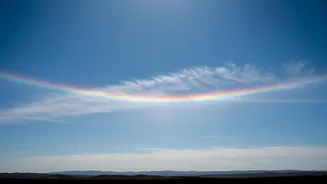
Not Fire, But Ice and Light
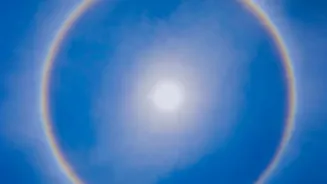
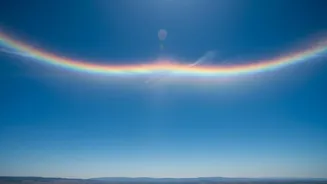
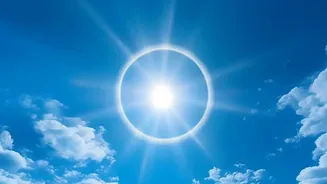
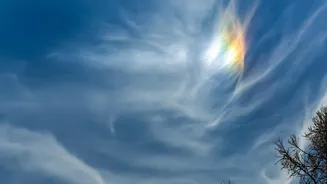
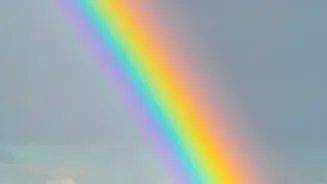
The breathtaking phenomenon popularly called a "fire rainbow" is known to scientists as a circumhorizontal arc. Its fiery appearance is an illusion; the vibrant colours are actually created by sunlight shining through tiny, plate-shaped ice crystals suspended
high in the atmosphere. This arc belongs to a family of optical wonders called ice halos. The term "fire rainbow," thought to have been coined around 2006, likely comes from the way the colours can appear like flames licking the sky, especially when seen in patchy, wispy cirrus clouds. Unlike a true rainbow, which is formed by the refraction and reflection of light in raindrops, a circumhorizontal arc is created only by the refraction, or bending, of light through these specific hexagonal ice crystals.
The NASA Connection
NASA frequently features stunning images of our universe through its Astronomy Picture of the Day (APOD) program, and circumhorizontal arcs are a recurring favorite. On August 2, 2026, APOD highlighted a spectacular example of a fire rainbow, explaining it as ice crystals in a distant cirrus cloud acting like millions of tiny floating prisms. This specific image was captured in West Virginia in 2021, but its reappearance in APOD brings fresh attention to this relatively rare sight. These images serve as a powerful reminder of the complex and beautiful physics constantly at play in our own atmosphere, turning simple elements like light and ice into a celestial spectacle.
The Recipe for a Fire Rainbow
Spotting a circumhorizontal arc requires a precise set of ingredients to come together. First and foremost, the sun must be very high in the sky—at an elevation of at least 58 degrees above the horizon. This is a key reason why the phenomenon is more common in mid-latitudes and is impossible to see in regions north or south of 55° latitude, where the sun never gets high enough. Secondly, the sky must contain the right kind of clouds: high-altitude cirrus or cirrostratus clouds. These clouds, found where temperatures are very low, are composed of the necessary hexagonal ice crystals. Finally, these plate-like crystals must be aligned horizontally, with their flat faces parallel to the ground, so they can collectively refract the sunlight like a single, giant prism.
A Skywatcher's Guide
If you want to see a fire rainbow in India, your best chances are during the midday hours in the summer months, when the sun is at its highest point in the sky. Look for thin, wispy cirrus clouds. The arc itself will appear as a colourful band parallel to the horizon, often located a significant distance below the sun. A key distinguishing feature is its colour pattern, which is always pure and well-ordered, with red on top and violet at the bottom. This sets it apart from a more common phenomenon called cloud iridescence, where the colours are more random and pastel-like. Wearing polarizing sunglasses can help make a faint arc more visible. While the conditions are specific, being aware of what to look for dramatically increases your chances of witnessing this fleeting atmospheric marvel.