
A New Window on the Sun
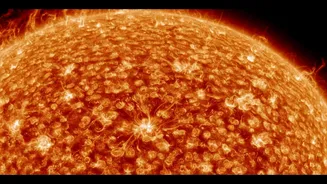
Scientists have captured an unprecedented look at the sun's surface, or photosphere, using the National Science Foundation's Daniel K. Inouye Solar Telescope in Hawaii. These are the highest-resolution images of our star ever taken, capable of distinguishing
features as small as 12 to 20 kilometers across. To put that in perspective, it is like being able to spot a small coin from 180 kilometers away. While the headline mentions NASA, the discovery comes from a ground-based observatory run by the National Science Foundation, with NASA's Astronomy Picture of the Day service highlighting the findings. This powerful new view is peeling back layers of the sun that have long been theorized about but never directly observed.
Unmasking the Swirls
For the first time, these images have confirmed the existence of tiny, swirling vortices of plasma at the edges of the sun's granular cells—the bright, bubbling patches that make up its surface. These structures, some just the size of a city, are the signature of a phenomenon known as the Kelvin-Helmholtz instability (KHI). This instability occurs when two fluids or plasmas moving at different speeds slide past one another, creating a shearing force that curls into waves and whirlpools. The same effect can be seen in the formation of clouds on Earth or the distinct bands in Jupiter's atmosphere. While scientists have long predicted KHI occurs on the sun, telescopes were never powerful enough to actually see it until now.
From Mystery to Mechanism
These city-sized swirls are more than just a fascinating visual; they provide a crucial piece of a long-standing solar puzzle. Scientists believe these instabilities act like tiny engines, twisting the sun's magnetic field lines like a coiled spring. This process stores immense amounts of magnetic energy. When these tangled field lines suddenly snap and reconnect, that stored energy can be explosively released. This could be a key mechanism driving everything from tiny nanoflares to colossal solar flares and coronal mass ejections—the powerful solar storms that can have significant effects on our planet. The constant churning of these vortices may be the everyday process that fuels the sun's most dramatic activity.
Solving a Burning Question
The discovery could also help solve one of the sun's most baffling mysteries: the coronal heating problem. The sun's outer atmosphere, the corona, is hundreds of times hotter than its visible surface, reaching millions of degrees Celsius while the surface below is a relatively cooler 5,500°C. How this extra energy gets into the corona has been a central question in astrophysics for decades. The Kelvin-Helmholtz swirls may provide an answer. By breaking down large flows of plasma into smaller and smaller movements, their energy can be converted into heat that is then transported into the upper atmosphere, contributing to the corona's extreme temperatures.
More Than Just a Pretty Picture
Understanding these fine-scale processes has very practical implications for life on Earth. The magnetic energy built up and released by the sun drives space weather, which can endanger astronauts, disrupt satellite communications for GPS and other services, and even damage power grids on the ground. By observing the very mechanisms that power these events, scientists hope to improve their models for predicting solar storms. These groundbreaking images move us from observing the effects of solar activity to understanding its fundamental causes, marking what the National Solar Observatory calls a "major step forward" in solar physics.