








The Challenge: Recreating Emotion
For a brand like Mercedes-AMG, the move to electric vehicles poses a unique existential threat. Customers don't just buy an AMG for its speed; they buy it for the multi-sensory experience — the roar of the exhaust, the vibration of the engine, and the visceral
connection to the machine. A silent, smooth EV, no matter how quick, risks losing that brand-defining character. The central problem for AMG engineers wasn't just making an EV fast, but making it feel like an AMG. This led to the development of a new, dedicated architecture for all-electric performance models, known as AMG.EA, which serves as the foundation for this new formula. The goal, as stated by company leadership, is to create a car that is an 'AMG first, and an EV second,' ensuring the brand's soul isn't lost in the transition.
The Formula for Speed and Range
The first two pillars of the formula—speed and range—are addressed by the bespoke AMG.EA platform. Unlike adapting existing electric platforms, this one was developed entirely from scratch in Affalterbach. Its core is a revolutionary drivetrain technology featuring innovative axial-flux motors. Developed by YASA, a company acquired by Mercedes, these motors are significantly lighter, more compact, and more power-dense than conventional radial-flux motors. This allows for incredible performance, with some configurations using three motors—one on the front axle and two at the rear—to generate outputs exceeding 1,000 horsepower. This technology underpins the ability to deliver not just blistering acceleration but also repeatable performance, a key differentiator from many EVs that lose steam after a few hard runs. Paired with a new high-performance, high-voltage battery using Formula 1-derived cooling technology, the system promises both consistent power and impressive range, with some models targeting over 600 kilometres on a single charge.
The Secret Sauce: Artificial Feedback
The most ambitious part of AMG's formula is engineering emotion through artificial feedback. This goes far beyond simply playing engine sounds through speakers. In a mode called AMGFORCE S+, the car transforms its behaviour. A complex system using over 1,600 sound files generates a dynamic V8-like sound in real-time, responding to throttle position and even simulating gear shifts that the driver can control with paddles. This isn't just about noise; it's about sensation. The system includes 'active seat shakers' that create vibrations to mimic the feel of a combustion engine, from the idle lope to the surge of acceleration. This 'holistic' experience is designed to provide the auditory and physical feedback that drivers use to connect with a car, creating a sense of exhilaration and control that has long been an AMG trademark.
The Vision Becomes Reality
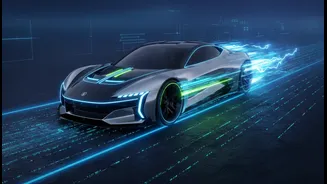
This new formula is no longer just a concept. It was first showcased in the Vision AMG concept car and is now making its way into production. The recently unveiled all-electric Mercedes-AMG GT 4-Door Coupé and the high-performance CLA 45 variants are the first vehicles built on these principles. The electric CLA 45, for instance, uses a three-motor setup to produce around 670 horsepower, achieving a 0-100 km/h sprint in under three seconds while offering a range of over 640 km. More importantly, it brings the full suite of artificial feedback to a production model. By blending cutting-edge electric hardware with a meticulously crafted sensory experience, AMG is betting that it can convince its loyal customers, and a new generation of buyers, that the future of performance is not silent, but synthetically, and thrillingly, loud.