



Meet NASA’s Newest Cosmic Explorer
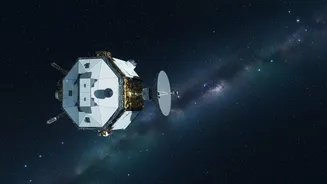
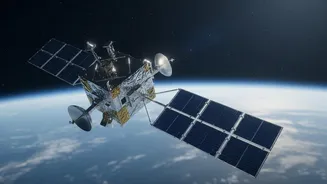
Launched in September 2025, the IMAP spacecraft is on a mission to a unique point in space about 1.5 million kilometres from Earth, called the L1 Lagrange point. From this stable perch, it has an uninterrupted view of the Sun and the vast boundary that
separates our solar system from the rest of the galaxy. This boundary, known as the heliosphere, is a massive, protective bubble inflated by the Sun’s constant stream of charged particles, called the solar wind. This bubble shields us from harsh interstellar radiation, making it a key reason our solar system can support life. IMAP’s job is to map this entire region, studying how the solar wind interacts with the material between the stars, known as the interstellar medium.
What Are These 'Particles at the Edge'?
IMAP is equipped with a suite of ten highly sensitive instruments designed to 'read' the particles that tell the story of this distant boundary. It can't visit the edge of the heliosphere directly—that's a journey that took the Voyager probes decades. Instead, it measures two crucial types of particles. First, it samples the solar wind that flows past it, providing real-time data on the particles coming from our Sun. Second, and most critically, it collects 'energetic neutral atoms' (ENAs). These are special particles created when the outbound solar wind collides with inbound neutral gas from interstellar space. Unlike charged particles, ENAs are not affected by magnetic fields and travel in straight lines. By capturing these messengers, scientists can trace their origins and create a 3D map of the heliosphere's structure and dynamics from afar.
The First Data Is Here
The exciting news for space enthusiasts is that this isn't just a future promise—it's happening now. Following its successful launch and instrument commissioning, NASA announced the first public release of IMAP science data in August 2026. Data collected through April 2026 from seven of the ten instruments is now available to the public. This release includes measurements of the interplanetary magnetic field, ions from the solar wind, and high-energy particles originating from both our Sun and deep space. This open data policy is a core part of NASA's mission, designed to allow the public and the broader scientific community to contribute to the process of discovery.
How to 'Read' the Data Yourself
So, how can you become a citizen scientist and explore this cosmic frontier? NASA has made accessing the data straightforward. The primary hub for the information is the IMAP Science Data Center, hosted by Princeton University, and NASA's own Space Physics Data Facility (SPDF). On these sites, you can find processed data from instruments like the magnetometer (MAG) and the Solar Wind and Pickup Ion instrument (SWAPI). For those interested in space weather, IMAP also provides a near-real-time data stream called I-ALiRT (IMAP Active Link for Real-Time). This system broadcasts uncalibrated data from five instruments, which is used by agencies like NOAA's Space Weather Prediction Center to provide early warnings of solar storms. While some data requires scientific software to analyze, the mission websites provide plots and visual tools, allowing anyone to see the latest measurements of our solar system's environment.
What We Hope to Discover
By studying this data, both scientists and the public can help answer some of the biggest questions in heliophysics. How are some particles accelerated to such high energies? How does the Sun's magnetic field interact with the galaxy's? And how does our heliospheric shield breathe and change in response to solar activity and its journey through the galaxy? Beyond mapping our cosmic neighborhood, IMAP's constant monitoring of the solar wind acts as a vital early-warning system. This gives about a half-hour heads-up for potentially harmful solar energetic particle events that can endanger astronauts, damage satellites, and disrupt power grids on Earth. Every new observation contributes not just to our scientific understanding, but also to our safety here at home.