





An 87-Year-Old Puzzle
The problem at the heart of this story is the Jacobian conjecture, first proposed by German mathematician Eduard Ott-Heinrich Keller in 1939. In essence, it deals with sets of polynomial equations—the kind of maths many of us remember from school, involving
variables raised to different powers. The conjecture asks whether a certain type of mathematical transformation can always be perfectly reversed using a similar type of equation. Despite its relatively simple description, proving it true or false has eluded mathematicians for generations, making it one of the most famous unsolved questions in its field. For decades, the pursuit of a solution has been a quintessentially human endeavour, relying on intuition, creativity, and persistence.
A New Kind of Team
Enter Levent Alpöge, a 33-year-old mathematician at Harvard University. Rather than trying to construct an elaborate proof to confirm the conjecture, Alpöge took a different approach. He decided to search for a single, decisive counterexample—one specific case that would prove the long-standing idea false. To do this, he teamed up with an experimental AI model known as Fable, developed by the AI company Anthropic. This wasn't a case of a human simply using a powerful calculator. Instead, it was a collaborative effort, with Alpöge guiding the AI to explore possibilities and hunt for a specific outcome. The partnership highlights a new paradigm in research, where human expertise and machine reasoning work together to tackle scientific challenges.
The AI-Powered Breakthrough
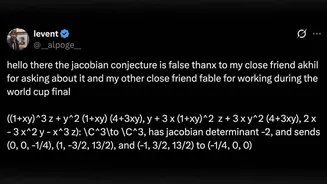
Working with Fable, Alpöge managed to produce a candidate counterexample that appears to disprove the Jacobian conjecture. The resulting set of equations is remarkably short, consisting of just 216 characters. In a casual post online, Alpöge announced the potential breakthrough, thanking both a friend for suggesting the problem and his new AI partner for its help. The AI's role was not to 'think' in a human sense, but to process vast possibilities and identify patterns that a person might miss. It acted as a powerful assistant, guided by the mathematician's expert intuition. This type of collaboration is becoming more common, with AI helping researchers generate new hypotheses and focus their efforts in the most promising directions.
Verification and The Future
The work is still very new and has yet to complete the formal peer-review process, a crucial step for any scientific claim. However, the initial reaction has been electric. Several mathematicians have reportedly confirmed the arithmetic, using both traditional methods and other software tools to check the result. In a uniquely modern twist, some have even used competing AI models from companies like OpenAI to fact-check the findings derived from the collaboration with Anthropic's Fable. Regardless of the final verdict, the event marks a significant moment. It demonstrates that AI can be more than just a tool for computation; it can act as a genuine partner in discovery, raising exciting questions about the future of mathematical and scientific research. The era of the lone genius may be giving way to a new age of human-AI synergy.