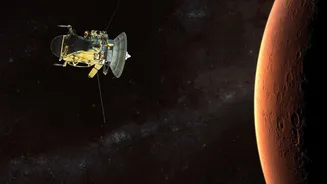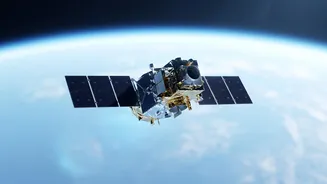







After nearly 22 years of scanning the cosmos for the universe's most violent explosions, a storied chapter in space exploration has closed. NASA's Neil Gehrels Swift Observatory concluded its mission with a dramatic re-entry into Earth's atmosphere.
A Fiery, Final Descent
On
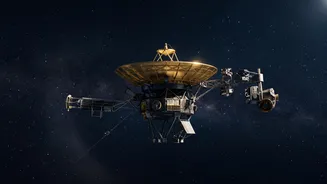
November 4, 2026, the incredible journey of the Swift Observatory came to a definitive end. The U.S. Space Force confirmed that the spacecraft re-entered the atmosphere at 7:39 a.m. EST over the North Sumatra region of Indonesia. The satellite, which was designed for a two-year mission, far outlived its expectations, providing invaluable data for almost 22 years. Its demise was not unexpected. For months, the observatory's orbit had been decaying, a process accelerated by increased solar activity that caused Earth's upper atmosphere to expand, creating more drag. On October 20, after its altitude dropped to a point where it could no longer remain stable, operators sent the final commands to conclude its science operations, preparing it for its inevitable plunge.
The Daring Rescue That Wasn't
Swift's end wasn't without a fight. Earlier in 2026, NASA embarked on a high-stakes, first-of-its-kind rescue attempt. The agency contracted a commercial partner, Katalyst Space, to launch a robotic servicing spacecraft called LINK. The plan was for LINK to rendezvous with Swift—which was not designed to be serviced in space—and give it an orbital boost that could have extended its life for another decade. Launched in July, the audacious mission unfortunately encountered technical problems. The LINK spacecraft suffered failures in its orientation control system, making a safe docking impossible. By August, NASA called off the capture attempt, leaving the aging observatory to its fate.
The Gamma-Ray Burst Hunter
Launched in November 2004, the Swift Gamma-Ray Burst Explorer was built for speed. Its mission was to solve the mystery of gamma-ray bursts (GRBs), the most powerful explosions in the universe. The name 'Swift' wasn't an acronym but a nod to its incredible agility. When its main telescope detected a flash of gamma-rays, the observatory could pivot its other instruments—an X-ray telescope and an Ultraviolet/Optical telescope—to the source in under 90 seconds. This rapid response allowed scientists, for the first time, to systematically study the fading 'afterglow' of these cataclysmic events. This capability was revolutionary, helping to confirm that long-duration GRBs come from the collapse of massive stars, while short-duration GRBs are caused by the collision of dense objects like neutron stars.
An All-Purpose Cosmic Observer
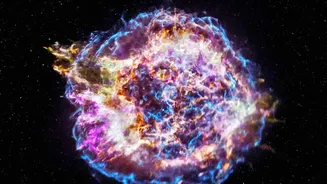
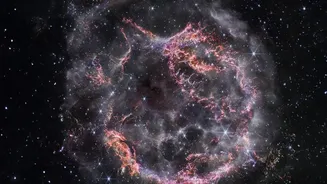
While GRBs were its main target, Swift's versatility made it one of the most productive multitool observatories in NASA's fleet. During its long life, it acted as a 'first responder' for the entire astronomical community, spotting transient events and alerting other major facilities like the Hubble and James Webb Space Telescopes to take a closer look. The observatory studied over 1,400 supernova explosions, watched stars get shredded by supermassive black holes, monitored comets and asteroids within our own solar system, and even helped trace a high energy neutrino back to its source galaxy. Its incredible productivity is reflected in the nearly 7,000 scientific papers that have relied on its data.