



A Glimpse into a Star's Finale
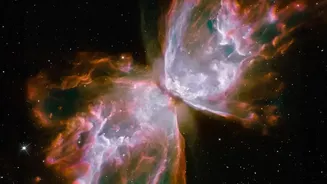
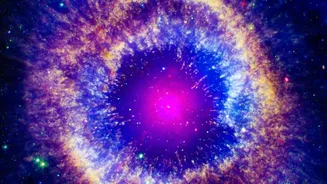
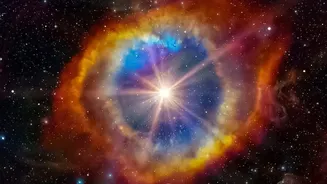
Our most powerful eye in the sky, the James Webb Space Telescope (JWST), has delivered breathtaking new views of one of the most famous celestial objects: the Ring Nebula. Also known as M57, this object is the glowing remnant of a star that has shed its
outer layers into space. Located about 2,500 light-years away, the Ring Nebula has been a favorite target for astronomers for centuries, but Webb's infrared vision cuts through the cosmic dust and gas to reveal its structure with astonishing clarity. The new images showcase the intricate, delicate filaments of the inner ring and the faint, concentric shells extending far beyond the main structure, painting a detailed picture of a star’s final, beautiful moments.
The Ghost of a Sun-Like Star
So, what exactly are we looking at? The Ring Nebula is a classic example of a planetary nebula—a somewhat misleading name, as it has nothing to do with planets. It’s what happens when a star between one and eight times the mass of our Sun runs out of fuel. As the star dies, it puffs its outer gaseous layers into space. At the center, the star's hot, dense core remains, now a white dwarf. This white dwarf bombards the expelled gas with ultraviolet radiation, causing it to glow in the vibrant colors we see. This process is a preview of our own Sun's distant future; in about five billion years, it will also create a planetary nebula, leaving a white dwarf behind.
The Mystery of the Cosmic Shells
One of the most captivating features revealed by Webb are the faint, concentric arcs, like ripples in a cosmic pond, that extend far beyond the nebula's main, bright ring. For a long time, the formation of these complex structures in planetary nebulae was a puzzle. A single, perfectly spherical star should create a simple, spherical nebula. However, the evidence from Webb strongly supports the theory that the central white dwarf isn't alone. Scientists believe a low-mass companion star is orbiting the white dwarf at a distance similar to that between our Sun and Pluto. As the dying star expelled its layers, this companion star's gravitational pull likely stirred things up, creating the intricate shells and filaments we see today.
A Story Written in Infrared Light
Previous images from telescopes like Hubble have shown the Ring Nebula's beauty, but Webb's instruments, NIRCam (Near-Infrared Camera) and MIRI (Mid-Infrared Instrument), provide a whole new layer of information. The infrared light reveals the distribution of different molecules, including carbon-based compounds called polycyclic aromatic hydrocarbons (PAHs) in the main shell. The images also show about 20,000 dense globules rich in molecular hydrogen within the nebula. This ability to see the chemical composition and temperature variations across the nebula allows astronomers to perform a kind of celestial archaeology, piecing together the history of the star that created this magnificent structure.
A Fleeting Cosmic Masterpiece
While stars live for billions of years, a planetary nebula is a remarkably fleeting phenomenon. The entire glorious display lasts for only a few tens of thousands of years. In the case of the Ring Nebula and others like it, astronomers estimate they will expand and fade away in about 10,000 to 20,000 years. The glowing gas will eventually disperse into the interstellar medium, becoming too thin and diffuse to be seen. This means we are living in a very specific, lucky moment in cosmic time, able to witness this star's spectacular death throes. In what is a mere blink of an eye in astronomical terms, this vibrant celestial artwork will be gone, its elements recycled to form new stars and planets.