

From Pioneer to Successor
The story of flight on Mars began with Ingenuity, a small, 1.8-kilogram helicopter that arrived on the Red Planet tucked under the Perseverance rover. Its mission was a technology demonstration: to prove that a rotorcraft could fly in the extremely thin
Martian atmosphere, which has just 1% of the density of Earth's. Ingenuity shattered all expectations, completing 72 flights over nearly three years and transforming our understanding of what's possible. It acted as an aerial scout for the rover, proving the immense value of an eye in the sky. Now, NASA is building on that legacy with Skyfall, a far more ambitious mission concept designed not just to fly, but to perform complex science.
What is the Skyfall Mission?
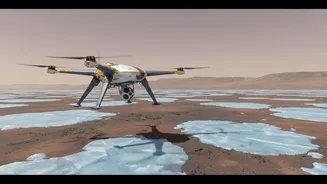
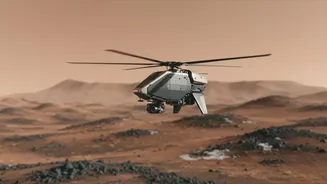
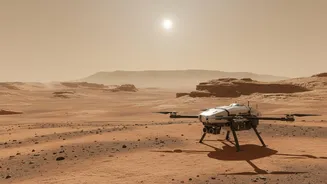
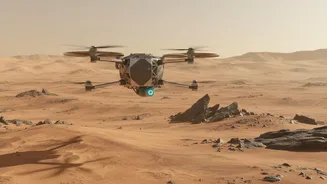
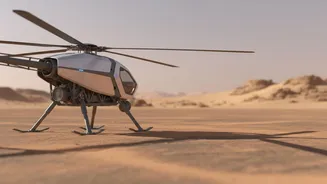
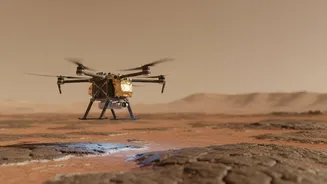
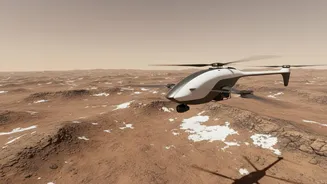
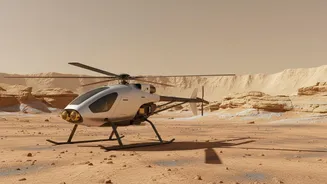
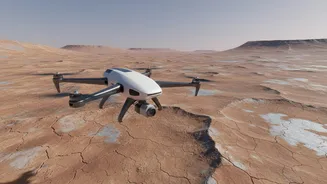
Skyfall is a proposed mission that would send a trio of next-generation helicopters to Mars. Unlike Ingenuity, which was a passenger on a rover, the Skyfall mission features a dramatic entry method befitting its name. The helicopters will be released mid-air from their protective aeroshell as it descends through the Martian atmosphere. They will then need to start flying and land themselves safely on the surface, a first for any Mars mission. These helicopters are designed to be larger, more capable, and fully autonomous, able to conduct science missions without relying on a nearby rover for communications. The mission, a collaboration between NASA's Jet Propulsion Laboratory and AeroVironment, is currently scheduled for a potential launch in late 2028.
The Search for Hidden Water Ice
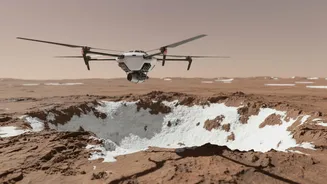
The primary goal of the Skyfall mission is to find buried water ice. While we know there is significant ice at the Martian poles, future human missions would ideally land in the more temperate mid-latitudes. Finding accessible water in these regions is critical, as it can be used for drinking, growing plants, and even being broken down into hydrogen and oxygen for rocket fuel. Orbiting spacecraft can detect deep ice deposits, but they struggle to see the top few meters of the surface, which is precisely where astronauts would need to access it. This is where Skyfall comes in. By flying low and slow, the helicopters can get a detailed look at the shallow subsurface in a way no orbiter or rover can.
How Skyfall Maps the Subsurface
Each Skyfall helicopter will be a flying science laboratory, equipped with a suite of advanced instruments. The key tool for ice-hunting is a unique ground-penetrating radar. The antenna for this radar is ingeniously designed as a flexible, fabric-like 'cape' that hangs beneath the helicopter. This allows it to get a clear view of the ground during flight. The radar sends signals into the Martian crust, scanning up to 10 feet deep or more, to create a 3D map distinguishing between layers of rock, dust, and ice. In addition to the radar, the helicopters will carry high-resolution cameras for 3D terrain mapping, near-infrared imagers to analyze surface composition, and sensors to measure temperature and wind.
Paving the Way for Human Exploration
Skyfall is more than just a search for water; it's a critical step in preparing for the arrival of astronauts on Mars. The detailed maps created by the helicopters will help scientists identify the most resource-rich and safest landing sites for future human missions. By scouting terrain that is too difficult or dangerous for rovers to reach, these aerial explorers can mitigate risks for the first Martian explorers. Ingenuity was the Wright Brothers' moment for Mars, a proof of concept that opened up a new dimension of exploration. Skyfall represents the next logical step, turning that potential into a powerful scientific tool that could finally unlock the resources needed to make humanity a multi-planetary species.