


The Challenge of Powering a Moon Base
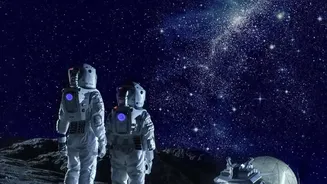
Establishing a sustainable habitat on the Moon isn't just about getting astronauts there; it's about keeping them alive and productive. That requires a constant, reliable source of energy. While solar power is a proven technology for space missions, it has
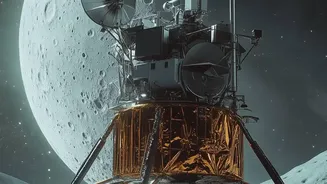
significant drawbacks on the Moon. The lunar night lasts for about 14 Earth days, plunging most of the surface into extreme cold and darkness. Relying solely on batteries to store enough solar energy to last two weeks would be impractical due to the immense weight and mass that would need to be launched from Earth. Any lunar base, especially one near the resource-rich but often shadowed poles, needs a power source that works 24/7, regardless of sunlight.
NASA's Solution: Fission Surface Power
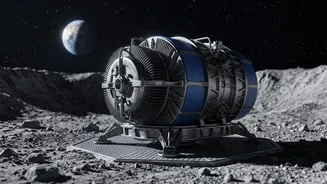
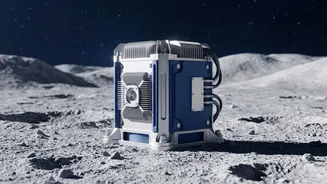
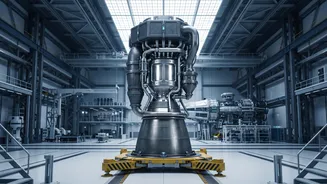
Enter the Fission Surface Power (FSP) project. In collaboration with the U.S. Department of Energy (DOE) and several industry partners, NASA is developing a small-scale nuclear fission reactor designed specifically for the lunar surface. The goal is to create a 40-kilowatt class power system, which is enough to continuously power about 30 households for at least ten years. Unlike large terrestrial nuclear plants, this reactor is designed to be relatively small and lightweight, allowing it to be fully assembled on Earth and transported to the Moon on a single lander. The project builds on decades of research, including the successful Kilopower project that concluded in 2018 with a full-scale nuclear test nicknamed KRUSTY (Kilopower Reactor Using Stirling Technology).
How It Will Work in the Lunar Environment
The plan is to deliver the reactor to the Moon, where it can be deployed with minimal setup, possibly with robotic assistance. Once activated, the uranium-fueled reactor would use nuclear fission to generate heat. This heat would then be converted into electricity. One of the key engineering hurdles is heat dissipation. On Earth, reactors are cooled by air or water, neither of which is available in the Moon's vacuum. Instead, the system will likely use large radiators to shed excess heat into space. The entire system is being designed to be robust enough to withstand the vibrations of launch and landing, as well as the extreme temperature swings of the lunar environment.
Powering the Future of Exploration
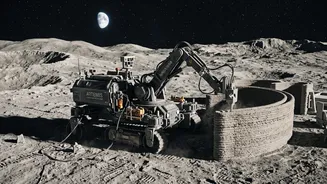
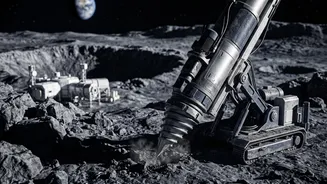
A reliable power source like a fission reactor is a game-changer for lunar exploration. It would provide the consistent energy needed for life support systems, lighting, and recharging rovers and scientific equipment. More excitingly, it enables advanced activities critical to long-term settlement. This includes 'in-situ resource utilization' (ISRU), such as mining for water ice believed to be trapped in permanently shadowed craters at the lunar poles. This water could be broken down into hydrogen and oxygen, providing breathable air for astronauts and propellant for rockets, effectively turning the Moon into a refueling station for missions deeper into space, including to Mars.
Safety, Competition, and the Path Forward
Launching nuclear material into space naturally raises safety questions. To mitigate risks, the reactor will be transported in a non-operational state, containing only weakly radioactive fresh uranium fuel. The system is also being designed to shut down automatically and safely in any off-normal conditions. NASA and the DOE have already awarded contracts to three industry teams—led by Lockheed Martin, Westinghouse, and IX (a joint venture of Intuitive Machines and X-Energy)—to develop competing designs. The goal is to have a reactor ready for a lunar demonstration by the early 2030s. This timeline is also influenced by geopolitical factors, as Russia and China have announced a joint plan to place a reactor on the Moon by the mid-2030s, adding a competitive element to this next phase of space exploration.