





A Planet Without a Clock
Measuring a day on a planet seems simple: you pick a landmark, like a mountain or a crater, and time how long it takes to spin back into view. But Saturn is a gas giant; it has no solid surface to track. For decades, scientists tried the next best thing:
measuring the rotation of its magnetic field. On planets like Earth and Jupiter, the magnetic axis is tilted relative to the rotational axis. This creates a regular, predictable wobble in radio signals, like a cosmic lighthouse beam that provides a clear rotation period. Saturn, however, refused to cooperate. Its magnetic axis is almost perfectly aligned with its rotational axis, meaning it spins with a serene stability that hides its true speed. This alignment left astronomers with conflicting and frustratingly imprecise measurements for years.
Listening to the Rings
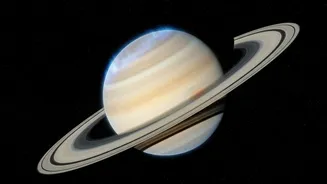
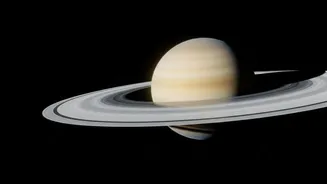
The solution to Saturn's spin mystery came not from its magnetic field, but from its most famous feature: the rings. In a brilliant feat of planetary science, researchers used data from the Cassini spacecraft to treat the rings like a giant seismograph. They discovered that the planet's deep interior vibrates as it rotates, and these subtle oscillations create waves in its gravitational field. These gravitational ripples, in turn, create tiny, measurable waves within the icy particles of the rings. By studying these wave patterns, scientists were finally able to bypass the silent magnetic field and effectively 'listen' to the heartbeat of the planet's core. This ingenious method yielded the most precise measurement to date: a day on Saturn lasts 10 hours, 33 minutes, and 38 seconds.
A Lopsided Magnetic Bubble
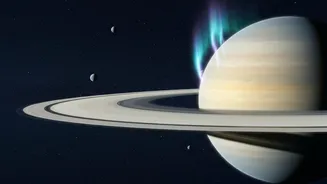
While the spin rate was being solved, other scientists continued to pore over Cassini's vast archive of magnetic data. Recent analysis has revealed another of Saturn's quirks: its magnetic field, or magnetosphere, is strangely misshapen. On Earth, the magnetosphere is largely shaped by the solar wind, the stream of particles flowing from the Sun. It creates a relatively symmetrical teardrop shape. But at Saturn, something else is in charge. The planet's incredibly fast rotation and the immense volume of charged particles spewed into space by its moon Enceladus combine to create a powerful internal force.
Rotation Over Solar Wind
This new analysis shows that Saturn's own spin dominates its magnetic environment. Instead of being neatly sculpted by the solar wind, the entire magnetic bubble gets dragged and twisted by the planet's rotation. One key feature, the magnetic cusp—a funnel-like opening near the poles—is dragged far into the planet's 'afternoon' side, rather than staying centered at noon as it does on Earth. This lopsided structure is confirmation of a long-held theory: for rapidly spinning gas giants, their own dynamics can overpower the influence of their star. The planet essentially creates its own magnetic weather system, driven by its speed and its active moons.
Why This Cosmic Detective Work Matters
Pinning down Saturn's rotation and mapping its magnetic field aren't just about solving cosmic puzzles. These fundamental properties are the building blocks for understanding everything else about the planet. The precise spin rate helps scientists create accurate models of Saturn's deep interior, its powerful winds, and its overall structure. Likewise, understanding the unique, rotation-dominated shape of its magnetosphere provides a crucial model for what the magnetic fields of giant exoplanets around other stars might look like. It shows that not all magnetospheres are like Earth's and provides a new template for planetary evolution across the galaxy. The data, gathered by the Cassini spacecraft which ended its mission in 2017, continues to be a gift that keeps on giving, revealing the secrets of the ringed planet years after the last signal was sent.