









The Universe’s Invisible Glue
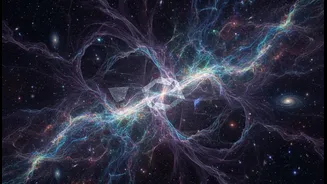
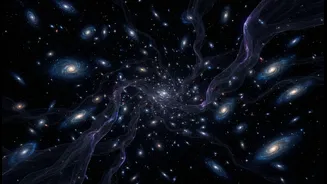
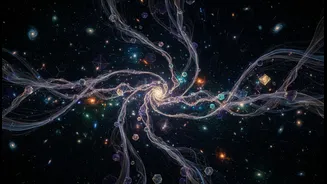
Imagine the universe as a cosmic web of galaxies. What holds it all together? For more than 80% of the universe's mass, the answer is dark matter. Scientists are certain it exists because they can see its immense gravitational effects. It is the invisible
'cosmic glue' that keeps stars from flying out of their galaxies and bends light across the cosmos. The problem is, despite decades of searching, no one has ever seen it or detected it directly. It doesn't emit, reflect, or interact with light, making it one of the biggest and most stubborn mysteries in all of physics.
The Problem with 'Perfect' Theories
In the search for dark matter, physicists have developed many theories. Some of these theories are incredibly elegant, but they come with a frustrating catch. To make the mathematics work, they often require a perfect, fine-tuned alignment of different physical properties, like the masses of hypothetical particles. This is what physicists call a 'calculation problem' or a 'fine-tuning problem'. It’s like trying to balance a pencil on its tip; it’s possible, but any tiny nudge will ruin it. Many scientists feel that if a theory requires such delicate, 'arranged by hand' precision, it's likely missing a deeper, more natural explanation.
Hiding in a Fifth Dimension
This is where the new theory, proposed by researchers from the University of Sheffield, comes in. They suggest that dark matter may exist in a hidden fifth spatial dimension. While we experience three dimensions of space (length, width, and height) and one of time, this idea posits there could be more, curled up so small that we can't perceive them. The proposal connects dark matter with this hidden dimension, suggesting it could reside there along with a hypothetical force-carrying particle called a 'dark photon'. This isn't just a wild guess; the idea of extra dimensions has been a serious topic in theoretical physics for years, as it could potentially solve several major puzzles at once.
How an Extra Dimension Creates Harmony
The beauty of this new model is that it gets rid of the fine-tuning problem. According to the theory, the specific geometry of this fifth dimension would naturally cause the masses of dark matter and dark photons to align perfectly. This creates a phenomenon the researchers call 'dark matter resonance'. Think of it like a guitar string: when you pluck it, it vibrates most intensely at its natural resonant frequency. Similarly, the geometry of the extra dimension naturally 'tunes' the dark matter particles, causing them to resonate. This resonance would have made dark matter interact strongly in the very early universe, but would explain why those interactions are almost undetectable today. The perfect alignment isn't a coincidence; it's a direct consequence of the dimension's shape.
A New Direction for a Decades-Old Hunt
This theory, while still purely theoretical, is exciting because it gives physicists a fresh perspective and new targets in their search. Instead of just looking for a single particle, they can now think about looking for signs of an extra dimension. For example, certain kinds of gravitational waves could be a clue that these hidden realms exist. This approach elegantly connects two of the biggest ideas in modern physics: the mystery of dark matter and the possibility of hidden dimensions. It provides a potential origin for why dark matter has been so elusive, suggesting it's not just hiding, but playing by a different set of rules in a space we can't see. By turning a complicated problem into a question of geometry, it simplifies the cosmic puzzle.