







Decoding the Martian Weather
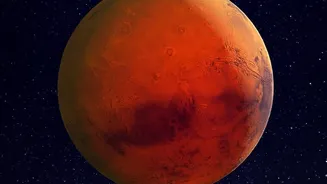
From a distance, Mars is a world of silent, rust-coloured plains and towering, extinct volcanoes. But closer inspection reveals a planet with a complex and often violent climate. Understanding this climate is one of the great challenges of planetary science,
and a recent study by Indian scientists has provided a major breakthrough. Researchers from the Physical Research Laboratory (PRL) in Ahmedabad have meticulously mapped the relationship between huge, planet-circling atmospheric waves and the dramatic temperature fluctuations seen on the Martian surface. This work, published in the journal Current Science, offers crucial new clues about how the Red Planet’s weather systems function and how it may have lost its atmosphere over billions of years. By focusing on two massive impact basins, Hellas and Argyre, the team has painted the most detailed picture yet of the forces shaping Mars’s environment.
What Exactly Are Zonal Waves?
Imagine watching ripples spread across a pond. By observing the pattern of the ripples, you can infer information about underwater currents you cannot see directly. Zonal waves on Mars work in a similar way. They are not waves of water, but large-scale, structured patterns in the atmospheric temperature that ripple across the planet. These waves are driven by the interaction between the thin atmosphere and the planet’s varied topography, like its vast basins and mountains. Mars's highly elliptical orbit also plays a significant role; the planet gets much closer to the Sun during its southern summer, leading to intense seasonal imbalances that fuel these atmospheric movements. For scientists, these waves are a vital tool, providing an indirect window into Mars's global air circulation and how heat is moved—or fails to be moved—around the planet.
Mapping Mars's Extreme Temperatures
The PRL scientists analysed data from the Emirates Mars Mission's Hope spacecraft to track these phenomena. Their findings revealed astonishing temperature swings. In the regions studied, surface temperatures can plummet to -123°C and soar to a relatively balmy 22°C. During the southern summer, some areas can even reach 27°C before rapidly cooling as soon as the sun sets. This volatility is largely due to Mars's thin atmosphere, which is about 100 times less dense than Earth's and cannot effectively store or distribute solar heat. The researchers observed that the two giant basins behaved differently. The Argyre basin was dominated by a simple, large-scale wave pattern (wave-1), while the deeper Hellas basin showed more complex and shifting patterns (wave-2 and wave-3), highlighting how profoundly the planet's geography dictates its weather.
Why This Discovery Is a Big Deal
This research does more than just chart Martian weather. It feeds into the central mystery of Mars: where did its ancient, thicker atmosphere go? Understanding how energy and particles move through the current thin atmosphere is crucial to modelling its past. The movement and dissipation of these waves play a role in atmospheric escape, the process by which a planet loses its air to space over geological time. Furthermore, this detailed thermal mapping has immediate practical applications. As humanity plans future robotic and, eventually, crewed missions to Mars, knowing the precise thermal behaviour of the surface is critical. Extreme temperature swings can affect the performance of landers, rovers, and habitats. This Indian-led research provides vital data that will inform the design of future missions and help select safer landing sites for the astronauts who will one day walk on the Red Planet.