





The Current Earth-Bound System
For decades, navigating in deep space has been a centralized process, entirely dependent on a lifeline to Earth. Every spacecraft, lander, and rover has relied on NASA's Deep Space Network (DSN), a global system of massive radio antennas, to determine
its position. This system works by sending signals from Earth to the spacecraft and back, a process that allows mission controllers to calculate its location and trajectory with incredible precision. While reliable, this method has significant limitations. The DSN is a finite and heavily overbooked resource, juggling communications with dozens of missions across the solar system. Scheduling time on the network is a constant logistical challenge. Furthermore, this reliance means that a lunar rover or astronaut has no true autonomy in navigation; they are always dependent on a continuous, real-time link with controllers millions of miles away. For the long-term, sustainable presence on the Moon envisioned by the Artemis program, this Earth-bound dependency is a critical bottleneck.
A GPS for the Moon?
NASA's solution is a game-changing piece of technology called the NavCube3-mini. This compact payload, about half the size of a shoebox, is designed to act as a specialized receiver that can pick up signals from Global Navigation Satellite Systems (GNSS) like the American GPS and European Galileo networks. These systems were designed to broadcast their signals toward Earth, not out into deep space. However, engineers discovered that by using highly sensitive receivers, they could detect the 'side lobes' of these signals—the weaker signals that spill out from the sides of the main broadcast beams—all the way out to the Moon. The NavCube3-mini is the culmination of this work, a small, lightweight, and low-power device capable of determining its precise position at lunar distances. By listening for signals from four or more GNSS satellites, it can triangulate its location just like your smartphone does on Earth, but in the vastness of cislunar space.
The Power of Autonomy
The ability for a rover or spacecraft to know its own position without 'phoning home' is transformative. This autonomous navigation capability offers immense benefits for future lunar operations. Firstly, it dramatically reduces the strain on the Deep Space Network, freeing up critical bandwidth for scientific data transmission and communication with missions further out in the solar system. Secondly, it provides real-time, on-board positioning for astronauts and rovers, which is crucial for safety and efficiency. During the Apollo missions, astronauts sometimes struggled to judge distances and identify landmarks, famously missing a crater they intended to visit by a mere 30 meters on Apollo 14. A lunar navigation system would eliminate this guesswork. For rovers, both crewed and robotic, it enables more complex and longer traverses, allowing them to navigate rugged terrain like that at the lunar South Pole with confidence and without constant human oversight. This autonomy is a cornerstone of making lunar exploration scalable and sustainable.
Paving the Way for Artemis
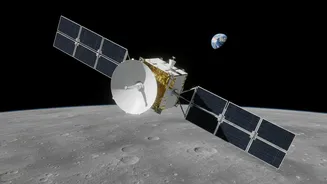
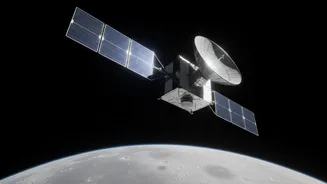
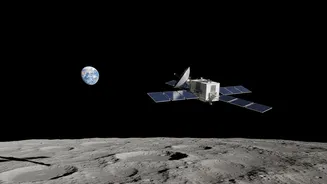
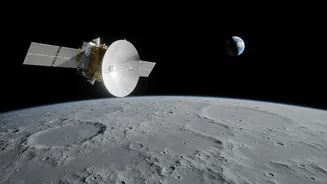
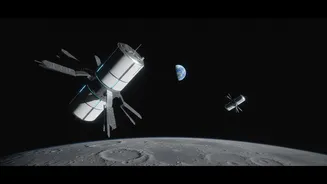
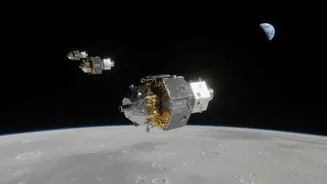
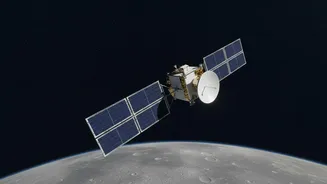
This new navigation technology is not just an experiment; it's a critical piece of infrastructure for NASA's Artemis program, which aims to establish a permanent human presence on the Moon. NASA is partnering with commercial companies like Intuitive Machines, which will integrate the NavCube3-mini into its Altus-1 lunar relay satellite as part of the Commercial Lunar Payload Services (CLPS) initiative. This mission will serve as a vital technology demonstration, proving the feasibility of using Earth's GNSS signals for reliable navigation in the lunar environment. This is a 'bridge technology'—an immediate solution that enables near-term missions while more robust, dedicated lunar-based navigation networks like the proposed LunaNet are built out. For the next generation of Lunar Terrain Vehicles (LTVs) and robotic explorers, this capability will be standard, allowing for complex scientific missions, resource prospecting, and the construction of a future Moon Base.