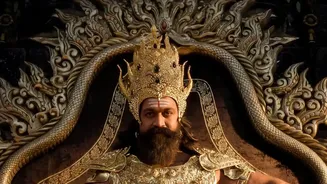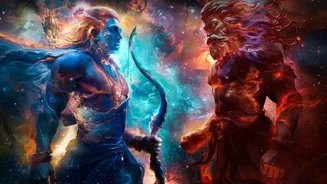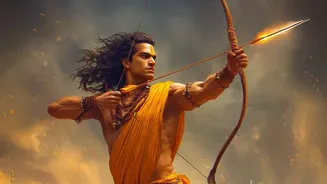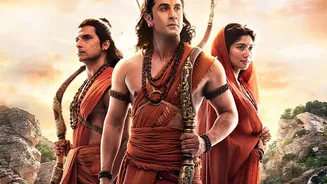



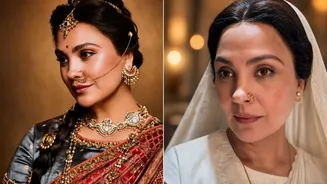
He is the fearsome antagonist of the Ramayana, a scholar of immense knowledge yet a king consumed by hubris. But the origin of his very name, Ravana, holds the key to his complex character, a name gifted by Lord Shiva himself in a moment of fury and grace.
Before He Was Ravana
Before he was the formidable king of Lanka known throughout the three worlds, he had a different name: Dashagriva or Dashanana. These names, meaning 'ten-necked' or 'ten-faced', referred to his striking physical form, born with ten heads that symbolized his mastery over the four Vedas and six Shastras. Born to the sage Vishrava and the Rakshasa princess Kaikasi, he was a figure of immense potential—a brilliant scholar, a powerful warrior, and a descendant of Brahma. His birth name described his appearance and intellect, but the name that would define his legacy was yet to be earned, forged in a crucible of arrogance and divine power.
A Clash of Egos at Kailash
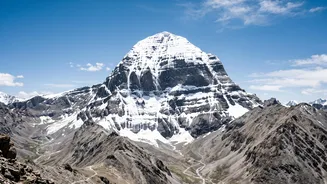
The pivotal story, recounted in the Uttara Kanda of the Ramayana and other texts, begins with an act of supreme arrogance. After defeating his half-brother Kubera and seizing his flying chariot, the Pushpaka Vimana, Dashagriva was flying back to Lanka when his path was blocked by Mount Kailash. The chariot could not fly over the mountain. When he sought the reason, he was confronted by Nandi, Shiva's bull-faced attendant, who informed him that no one was allowed to pass as Lord Shiva and Parvati were resting atop the mountain. Infuriated by this obstruction and mocking Nandi, Dashagriva decided he would not go around the mountain—he would move it altogether. In a display of his colossal strength, he put his twenty arms beneath Kailash and began to lift it.
The Mountain and The Toe
As the great mountain began to tremble under Dashagriva's might, a terrified Parvati turned to Shiva. The omniscient lord, fully aware of the rakshasa king's audacious act, simply smiled. With no great effort, Shiva pressed down on the mountain with his big toe. The effect was immediate and absolute. The mountain, which a moment ago was being lifted, slammed back into place, trapping Dashagriva's arms beneath its immense weight. The king who believed his power was limitless was instantly humbled, pinned by a casual gesture from the divine. His strength, which had conquered gods and looted celestial cities, was rendered utterly useless against the might of Mahadeva.
The Cry That Named a King
Trapped and in excruciating pain, Dashagriva let out a terrifying cry, a roar of agony so loud that it was said to have shaken all three worlds. It is this momentous, earthshattering scream that gave him his famous name. Advised by his ministers, and realizing the futility of his arrogance, the trapped king's actions turned from pride to penance. For what is said to be a thousand years, he sang hymns in praise of Shiva. Pleased by this display of devotion, Shiva finally released him. It was then that Shiva bestowed upon him the name 'Ravana', derived from the Sanskrit root 'ru', meaning 'to roar' or 'to cry loudly'. He was forever named for the sound of his own painful scream.
A Name of Power and Pain
The name Ravana is therefore a paradox. It is a reminder of his greatest humiliation, a mark of the moment his ego was crushed by a power far greater than his own. Yet, it was a name given by Shiva himself, earned through an act of both supreme arrogance and profound devotion. Following this event, a pleased Shiva also granted him an invincible sword, the Chandrahasa. Thus, the encounter that gave him his name also armed him with even greater power. The name Ravana encapsulates his entire being: a being of terrifying power ('one who makes the world cry out') and one who himself cried out in agony and submission. It represents the duality of the learned scholar and the arrogant king, the devout follower and the fearsome antagonist, cementing his place as one of mythology's most complex and compelling figures.