







More Than Just a Race
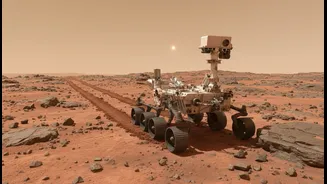
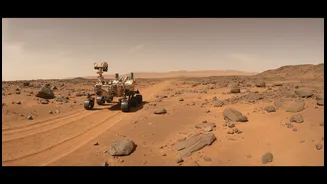
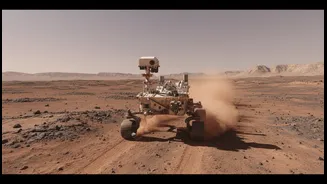
On June 14, 2026, after five years and four months on the Red Planet, the Perseverance rover officially logged 42.195 kilometres of travel. This achievement makes it only the second rover to complete a marathon on another world, after the legendary Opportunity
rover. However, Perseverance achieved this milestone in less than half the time it took Opportunity, which needed over 11 years for the same distance. While this is a testament to improved technology, the five-year duration underscores the mission's true purpose: this was never a race. The journey's length is a direct result of the complex tasks assigned to the car-sized robotic geologist in Mars's unforgiving Jezero Crater.
Navigating a Hostile World
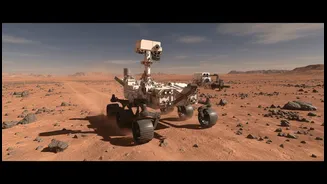
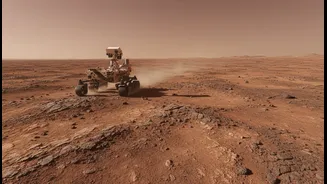
Driving on Mars is profoundly challenging. Mission planners at NASA's Jet Propulsion Laboratory must meticulously map out routes, avoiding hazards that could end the multi-billion dollar mission. The terrain is littered with sharp rocks that can damage wheels, sand traps that can immobilize the rover, and steep slopes. To navigate this, Perseverance uses an advanced autonomous system called AutoNav. This allows the rover to make its own driving decisions, creating 3D maps of the terrain ahead to identify and steer around obstacles without real-time input from Earth. This "thinking while driving" capability is a significant upgrade from previous rovers and allows for longer, safer drives, but caution remains the priority. Every metre is hard-won, with the rover's top speed a blistering 0.16 kilometres per hour.
The Science of Stopping
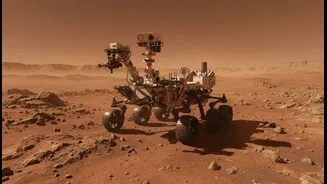
The primary reason for the rover's deliberate pace is its main objective: searching for signs of ancient microbial life. This isn't a simple road trip; it's a geological field expedition. Perseverance frequently stops for days or weeks at a time to analyze promising rock formations. Its mission involves identifying environments that might have been habitable billions of years ago when Jezero Crater was a lake. The rover uses a suite of sophisticated instruments, including drills, cameras, and spectrometers, to examine the composition of rocks. The most time-consuming task is collecting samples. This involves drilling into rock, extracting a core about the size of a piece of chalk, sealing it in an ultra-clean titanium tube, and storing it for a future mission to return to Earth.
A Five-Year Feat of Engineering
Since landing on February 18, 2021, Perseverance has been operating for over 1,900 Martian days (sols). The fact that it has not only survived but thrived for over five Earth years is an engineering marvel. The rover is powered by a Radioisotope Thermoelectric Generator (RTG), which converts heat from the decay of plutonium into electricity, allowing it to operate through harsh Martian winters and dust storms that would cripple a solar-powered vehicle. This longevity is crucial, as the sample collection campaign is a meticulous, long-term project. The rover has already collected dozens of rock, soil, and even atmospheric samples, caching a backup depot on the Martian surface in case of a problem before the planned retrieval mission.
The Road Ahead
Having completed its marathon, Perseverance's journey is far from over. The rover continues to push the boundaries of exploration, heading toward new geological frontiers within and beyond Jezero Crater. Its mission is to continue assembling the most scientifically valuable set of samples possible. Each sample tells a piece of Mars's planetary history, from its watery past to its potential for harbouring life. The data and samples collected are not just for us, but for future generations of scientists who will study these pristine pieces of another world in advanced laboratories on Earth, a return trip planned for the next decade. Perseverance is now closing in on Opportunity's all-time off-world driving record of 45.16 kilometres, another milestone in its remarkable Martian expedition.