

Shattering the Cosmic Snow Globe
For much of human history, our perspective of the cosmos has been that of serene, isolated islands of stars. We imagined galaxies as majestic, self-contained systems, like ships passing silently in the vast ocean of night. This view, of a mostly unchanging
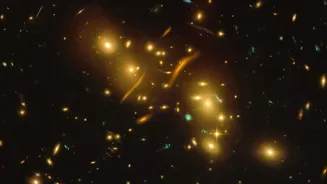
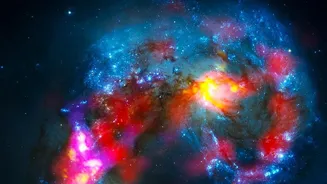
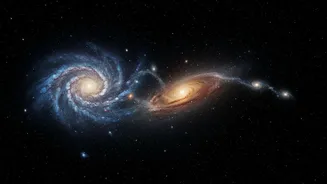
and orderly universe, is what could be called a misleading cosmic perspective. It’s a comforting thought, but one that modern astronomy is systematically dismantling. The truth is far more chaotic, interactive, and ultimately, more interesting. Recent observations, particularly from the Hubble Space Telescope, have provided a steady stream of evidence showing that galaxies are not isolated entities; they regularly interact, collide, and merge in processes that take hundreds of millions of years.
A Gallery of Galactic Encounters
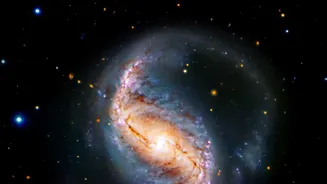
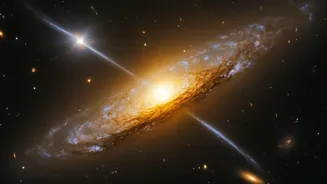
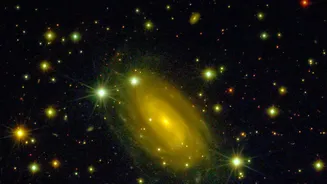
Rather than one single photograph, NASA has been building a family album of peculiar and interacting galaxies. Take the trio known as NGC 7764A, located about 425 million light-years away. In this system, two of the three galaxies are visibly twisted and drawn out, with long trails of stars and gas suggesting a powerful gravitational tango is underway. Another spectacular example is Arp-Madore 417-391, a pair of galaxies whose collision was so perfectly aligned that it created a colossal, nearly-perfect ring of stars, gas, and dust 670 million light-years away. Then there is Arp 107, a duo connected by a tenuous 'bridge' of material, showing one galaxy siphoning matter from its smaller companion. Each of these images tells a story not of quiet existence, but of a dynamic and ongoing process of cosmic evolution.
The Creative Force of Collisions
The phrase 'galactic collision' sounds purely destructive, but it is one of the most important creative forces in the universe. When galaxies merge, their vast clouds of gas and dust are compressed, triggering furious bursts of star formation known as 'starbursts'. These events can forge millions of new stars in a relatively short amount of cosmic time. The gravitational forces at play are immense, creating what are known as 'tidal tails'—long, graceful arcs of stars and gas flung out from the merging galaxies. Over millions of years, a process called 'violent relaxation' completely scrambles the orbits of stars. This is how two beautiful, orderly spiral galaxies can merge and transform into a larger, more disordered elliptical galaxy, representing a fundamental step in galactic evolution.
A Glimpse of Our Own Future
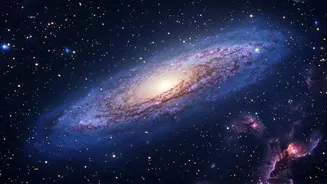
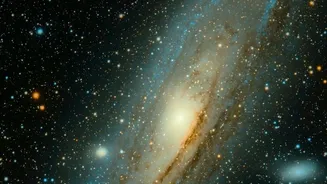
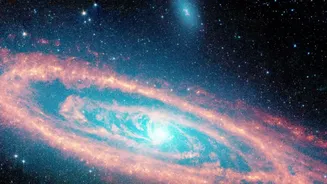
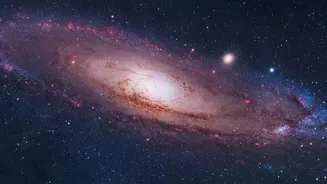
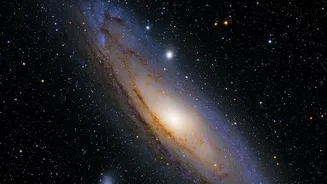
This cosmic demolition derby is not just something that happens to distant, exotic galaxies; it is the likely future of our own Milky Way. Astronomers predict that in about 4.5 billion years, our galaxy is set for a head-on collision with our nearest large neighbor, the Andromeda Galaxy. While the timeline has been subject to new research and debate, the eventual merger seems inevitable. When this happens, it will not be an apocalypse for any life that might exist. The distances between individual stars are so vast that it's incredibly unlikely any two stars will actually collide. Instead, from a vantage point on Earth, the night sky would slowly transform over millions of years, filled with the brilliant light of new star formation as the two galaxies merge into one, a new, larger entity sometimes nicknamed 'Milkomeda'.