






Pluto's Famous Frozen Heart
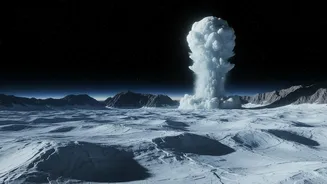
Ever since NASA's New Horizons spacecraft flew past Pluto in 2015, scientists have been captivated by Sputnik Planitia, the western lobe of its iconic heart-shaped feature. This enormous basin, larger than Texas and Oklahoma combined, is a colossal glacier
made not of water ice, but of frozen nitrogen. Early images revealed a stunningly young surface, with city-sized cells of ice slowly churning in a process called convection. This constant renewal explained the lack of craters, indicating a geologically active world. Yet, the full story of this dynamic region was still incomplete.
Telltale Stains on the Ice
A new study has provided a fascinating clue. Researchers closely re-examined New Horizons images of the northern part of Sputnik Planitia. They noticed dark, linear streaks and diffuse patches along the boundaries of the convection cells. On a world as frigid as Pluto, what could be causing these markings? The team, led by Alan Stern of the Southwest Research Institute, drew a comparison to a more familiar place: Greenland. On Earth's ice sheets, similar dark features are created when liquid water wets the snow and ice. The patterns on Pluto looked strikingly similar, leading to a bold hypothesis.
An Impossible Rain
The immediate thought of liquid might lead one to imagine rain. However, Pluto's atmospheric conditions make liquid nitrogen rain an impossibility. Its atmosphere is incredibly thin and surface temperatures hover around a bone-chilling -230°C. So if the liquid wasn't coming from above, scientists concluded it must be coming from below. This suggested that somewhere deep beneath the frozen plains of nitrogen, conditions were right for liquid to exist and find its way to the surface. The discovery points not to a weather system, but to a hidden geological engine.
A Process from Deep Below
To test this idea, computer models were developed to simulate the conditions deep within the Sputnik Planitia glacier, which is several kilometres thick. These models, led by scientist Orkan Umurhan, showed that the immense pressure from the overlying ice could be enough to melt the nitrogen ice at its very base, creating pockets of liquid. This liquid nitrogen, being slightly less dense than the solid ice around it, would be buoyant. The models suggest this liquid is then forced upward through cracks and conduits in the ice, eventually erupting onto the surface in a process more akin to volcanism than a spring.
A New, Dynamic Pluto
Once on the surface, the liquid nitrogen would briefly flow, wetting the ground and creating the dark stains seen in the images before quickly refreezing. This is the first strong evidence for recently flowing liquid on Pluto. It transforms our understanding of the dwarf planet from a mostly static, frozen ball to a world with ongoing, dynamic geological processes. The surface of Sputnik Planitia is estimated to be less than a million years old—a blink of an eye in cosmic terms—meaning these liquid flows could be a relatively recent, or even currently occurring, phenomenon. As Alan Stern, the lead author of the study, noted, Pluto never stops surprising us.