




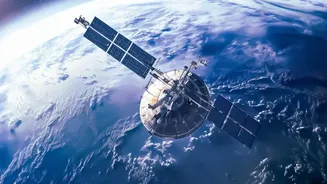
Meet Our New Space Weather Sentinel
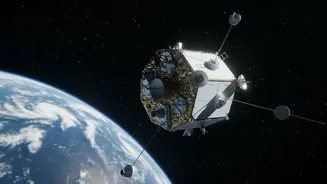
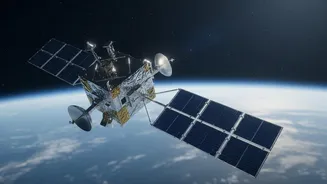
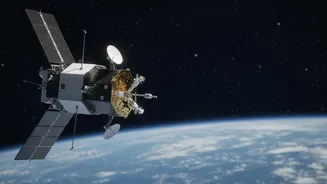
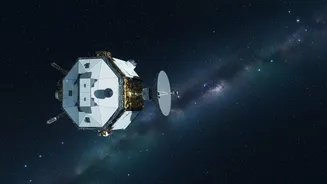
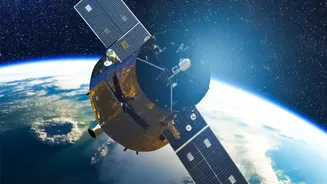
Launched in September 2025, NASA's Interstellar Mapping and Acceleration Probe, or IMAP, is a state-of-the-art observatory on a crucial mission. Positioned at a gravitationally stable spot one million miles from Earth towards the Sun, it has an uninterrupted
view of the solar wind. The mission, led by Princeton University, has two primary goals: to understand how the solar wind interacts with the galaxy and to study the acceleration of particles that pose a threat to our technology and astronauts. After reaching its destination in early 2026 and beginning its science mission, IMAP is now our dedicated sentinel, standing guard against the constant onslaught of solar particles.
The Sun's Constant, Powerful Breath
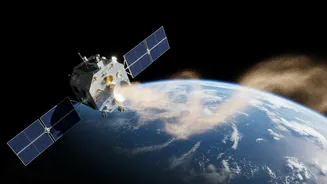
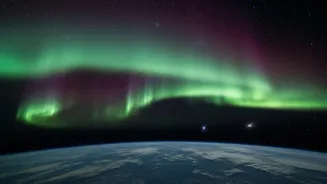
The solar wind is a continuous stream of charged particles—mostly protons and electrons—that flows outward from the Sun's corona at speeds up to 800 kilometers per second. When this stream interacts with Earth's magnetic field, it can produce the stunning Northern and Southern Lights. However, this interaction is not always so benign. Sudden, violent bursts from the Sun, known as coronal mass ejections, can supercharge the solar wind, triggering geomagnetic storms. These storms can damage satellites, disrupt GPS and communication networks, overload power grids, and pose a radiation risk to astronauts. In our highly connected and technology-dependent world, understanding and forecasting this 'space weather' has become critically important.
A Flood of New Information
In a major milestone, NASA made the first batch of IMAP's scientific findings public in early August 2026. Data collected by seven of the spacecraft’s ten highly sensitive instruments is now available to scientists and the public worldwide. This initial release includes measurements from instruments like MAG, which precisely tracks the interplanetary magnetic field, and SWAPI, which counts and analyzes the ions making up the solar wind. This isn't just more of the same data; it's a higher-fidelity, more comprehensive look at the space environment between the Sun and Earth than ever before. It provides a real-time, three-dimensional picture of the forces shaping our corner of the solar system.
Why This Forecast Matters for India
This advanced knowledge is not just an academic pursuit. One of IMAP's key functions is the IMAP Active Link for Real-Time (I-ALiRT) data stream. This system provides a continuous flow of space weather data, giving forecasters on Earth an early warning—about half an hour—of incoming solar disturbances. For a nation with growing technological ambitions like India, this is invaluable. Better space weather predictions can help protect crucial infrastructure, from the NavIC satellite navigation system to the national power grid. Furthermore, as India advances its human spaceflight program, Gaganyaan, understanding the radiation environment is essential for astronaut safety. IMAP’s data provides a critical layer of protection for these national assets and ambitions.
A New Chapter in Solar Science
This first data release is just the beginning of IMAP's two-year primary mission. As the probe continues its work, it will build a complete map of our heliosphere—the protective magnetic bubble that the solar wind inflates around our solar system. By making the data public, NASA is inviting a global community of researchers to dig in, fostering collaboration and accelerating discovery. Over the coming months and years, the insights gathered from IMAP will not only refine our space weather forecasts but also help answer fundamental questions about our Sun's influence on the solar system and the nature of the interstellar space beyond. It's a new era of seeing our local cosmic environment with unprecedented clarity.